Advertisements
Advertisements
प्रश्न
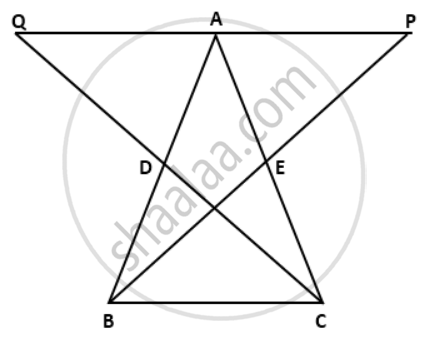
In ΔABC, the medians BE and CD are produced to the points P and Q respectively such that BE = EP and CD = DQ. Prove that: A is the mid-point of PQ.
Advertisements
उत्तर

In ΔBDC and ΔADQ,
CD = DQ ....(given)
∠BDC = ∠ADQ ....(vertically opposite angles)
BD = AD ....(D is the mid-point of AB)
∴ ΔBDC ≅ ΔADQ
⇒ ∠DBC = ∠DAQ (c.p.c.t)....(i)
And, BC = AQ (c.p.c.t)....(ii)
Similarly, we can prove ΔCEB ≅ ΔAEP
⇒ ∠ECB = ∠EAP (c.p.c.t)....(iii)
And, BC = AP (c.p.c.t)....(iv)
From (ii) and (iv),
AQ = AP
⇒ A is the mid-point of PQ.
APPEARS IN
संबंधित प्रश्न
ABCD is a rectangle and P, Q, R and S are mid-points of the sides AB, BC, CD and DA respectively. Show that the quadrilateral PQRS is a rhombus.
In below fig. ABCD is a parallelogram and E is the mid-point of side B If DE and AB when produced meet at F, prove that AF = 2AB.

In Fig. below, BE ⊥ AC. AD is any line from A to BC intersecting BE in H. P, Q and R are
respectively the mid-points of AH, AB and BC. Prove that ∠PQR = 90°.

ABCD is a quadrilateral in which AD = BC. E, F, G and H are the mid-points of AB, BD, CD and Ac respectively. Prove that EFGH is a rhombus.

In the given figure, AD and CE are medians and DF // CE.
Prove that: FB = `1/4` AB.
In triangle ABC; M is mid-point of AB, N is mid-point of AC and D is any point in base BC. Use the intercept Theorem to show that MN bisects AD.
In ΔABC, AB = 12 cm and AC = 9 cm. If M is the mid-point of AB and a straight line through M parallel to AC cuts BC in N, what is the length of MN?
In parallelogram ABCD, P is the mid-point of DC. Q is a point on AC such that CQ = `(1)/(4)"AC"`. PQ produced meets BC at R. Prove that
(i) R is the mid-point of BC, and
(ii) PR = `(1)/(2)"DB"`.
In ΔABC, P is the mid-point of BC. A line through P and parallel to CA meets AB at point Q, and a line through Q and parallel to BC meets median AP at point R. Prove that: AP = 2AR
In the given figure, PS = 3RS. M is the midpoint of QR. If TR || MN || QP, then prove that:
RT = `(1)/(3)"PQ"`