Advertisements
Advertisements
प्रश्न
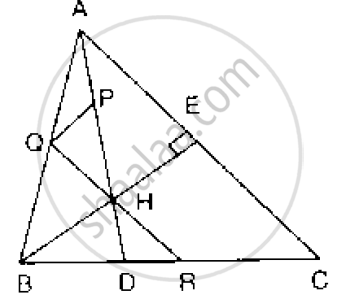
In Fig. below, BE ⊥ AC. AD is any line from A to BC intersecting BE in H. P, Q and R are
respectively the mid-points of AH, AB and BC. Prove that ∠PQR = 90°.
Advertisements
उत्तर
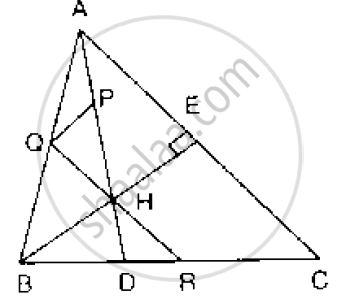
Given
BE ⊥ AC and P, Q and R are respectively midpoint of AH , AB and BC
To prove:
`∠`PQRD = 90°
Proof: In ΔABC, Q and R are midpoints of AB and BC respectively
∴QR || AC ......(i )
In ΔABH , Q and P are the midpoints of AB and AH respectively
∴ QP || BH
⇒ QP || BE ......(ii )
But, AC ^ BE ∴ from equation (i) and equation (ii) we have
QP ⊥ QR
⇒ `∠`PQR = 90°, hence proved.
APPEARS IN
संबंधित प्रश्न
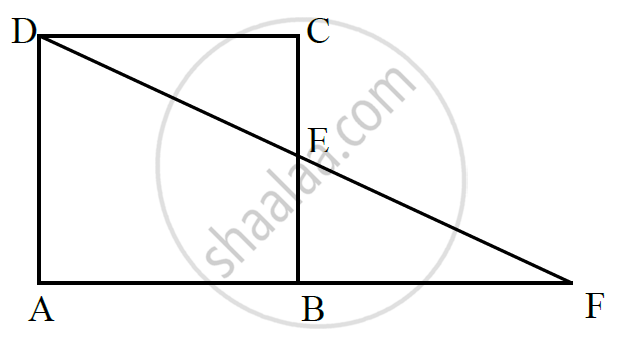
In below fig. ABCD is a parallelogram and E is the mid-point of side B If DE and AB when produced meet at F, prove that AF = 2AB.
ABCD is a kite having AB = AD and BC = CD. Prove that the figure formed by joining the
mid-points of the sides, in order, is a rectangle.
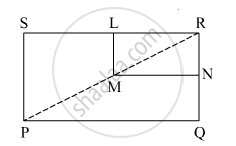
In the given figure, `square`PQRS and `square`MNRL are rectangles. If point M is the midpoint of side PR then prove that,
- SL = LR
- LN = `1/2`SQ
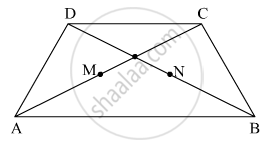
In the adjacent figure, `square`ABCD is a trapezium AB || DC. Points M and N are midpoints of diagonal AC and DB respectively then prove that MN || AB.
Prove that the figure obtained by joining the mid-points of the adjacent sides of a rectangle is a rhombus.
In the given figure, M is mid-point of AB and DE, whereas N is mid-point of BC and DF.
Show that: EF = AC.
If the quadrilateral formed by joining the mid-points of the adjacent sides of quadrilateral ABCD is a rectangle,
show that the diagonals AC and BD intersect at the right angle.
In parallelogram PQRS, L is mid-point of side SR and SN is drawn parallel to LQ which meets RQ produced at N and cuts side PQ at M. Prove that M is the mid-point of PQ.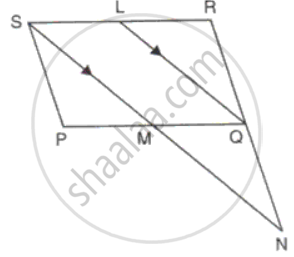
In the given figure, ABCD is a trapezium. P and Q are the midpoints of non-parallel side AD and BC respectively. Find: DC, if AB = 20 cm and PQ = 14 cm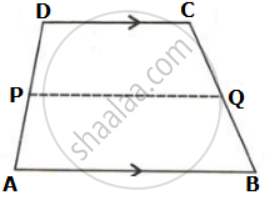
In ΔABC, the medians BE and CD are produced to the points P and Q respectively such that BE = EP and CD = DQ. Prove that: A is the mid-point of PQ.
