मराठी

In δAbc, the Medians Be and Cd Are Produced to the Points P and Q Respectively Such that Be = Ep and Cd = Dq. Prove That: a is the Mid-point of Pq. - Mathematics

Advertisements
Advertisements

प्रश्न

In ΔABC, the medians BE and CD are produced to the points P and Q respectively such that BE = EP and CD = DQ. Prove that: A is the mid-point of PQ.

बेरीज
Advertisements

उत्तर
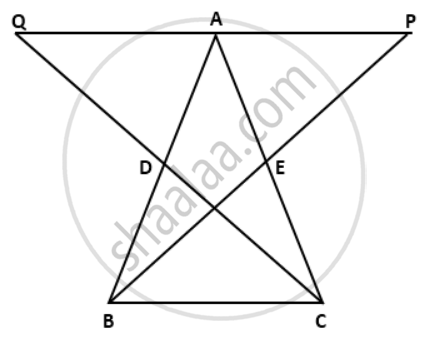

In ΔBDC and ΔADQ,
CD = DQ ....(given)
∠BDC = ∠ADQ ....(vertically opposite angles)
BD = AD ....(D is the mid-point of AB)
∴ ΔBDC ≅ ΔADQ   
⇒ ∠DBC = ∠DAQ  (c.p.c.t)....(i)
And, BC = AQ         (c.p.c.t)....(ii)
Similarly, we can prove ΔCEB ≅ ΔAEP
⇒ ∠ECB = ∠EAP   (c.p.c.t)....(iii)
And, BC = AP         (c.p.c.t)....(iv)

From (ii) and (iv),
AQ = AP
⇒ A is the mid-point of PQ.

shaalaa.com
  या प्रश्नात किंवा उत्तरात काही त्रुटी आहे का?
पाठ 15: Mid-point and Intercept Theorems - Exercise 15.2

APPEARS IN

फ्रँक Mathematics [English] Class 9 ICSE
पाठ 15 Mid-point and Intercept Theorems
Exercise 15.2 | Q 2.2

संबंधित प्रश्‍न

ABCD is a quadrilateral in which P, Q, R and S are mid-points of the sides AB, BC, CD and DA (see the given figure). AC is a diagonal. Show that:

  1. SR || AC and SR = `1/2AC`
  2. PQ = SR
  3. PQRS is a parallelogram.


In the below Fig, ABCD and PQRC are rectangles and Q is the mid-point of Prove thaT

i) DP = PC (ii) PR = `1/2` AC


In the Figure, `square`ABCD is a trapezium. AB || DC. Points P and Q are midpoints of seg AD and seg BC respectively. Then prove that, PQ || AB and PQ = `1/2 ("AB" + "DC")`.


In triangle ABC, the medians BP and CQ are produced up to points M and N respectively such that BP = PM and CQ = QN. Prove that:

  1. M, A, and N are collinear.
  2. A is the mid-point of MN.

In parallelogram ABCD, P is the mid-point of DC. Q is a point on AC such that CQ = `(1)/(4)"AC"`. PQ produced meets BC at R. Prove that

(i) R is the mid-point of BC, and

(ii) PR = `(1)/(2)"DB"`.


AD is a median of side BC of ABC. E is the midpoint of AD. BE is joined and produced to meet AC at F. Prove that AF: AC = 1 : 3.


In a parallelogram ABCD, E and F are the midpoints of the sides AB and CD respectively. The line segments AF and BF meet the line segments DE and CE at points G and H respectively Prove that: ΔHEB ≅ ΔHFC


In a parallelogram ABCD, E and F are the midpoints of the sides AB and CD respectively. The line segments AF and BF meet the line segments DE and CE at points G and H respectively Prove that: EGFH is a parallelogram.


In the given figure, T is the midpoint of QR. Side PR of ΔPQR is extended to S such that R divides PS in the ratio 2:1. TV and WR are drawn parallel to PQ. Prove that T divides SU in the ratio 2:1 and WR = `(1)/(4)"PQ"`.


The quadrilateral formed by joining the mid-points of the sides of a quadrilateral PQRS, taken in order, is a rhombus, if ______.


Share
Notifications

Englishहिंदीमराठी


      Forgot password?
Use app×