Advertisements
Advertisements
प्रश्न
AD is a median of side BC of ABC. E is the midpoint of AD. BE is joined and produced to meet AC at F. Prove that AF: AC = 1 : 3.
Advertisements
उत्तर
Construction: Draw DS ∥ BF, meeting AC at S.
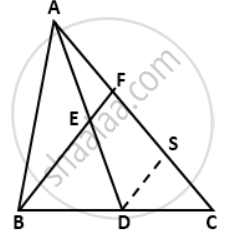
Proof:
In ΔBCF, D is the mid-point of AC DS || BF.
∴ S is the mid-point of CF.
⇒ CS = SF ....(i)
In ΔADS, E is the mid-point of AD and EF || DS.
∴ F is the mid-point of AS.
⇒ AF = FS ....(ii)
From (i) and (ii), we get
AF = FS = SC
⇒ AC = AF = FS + SC
⇒ AC = AF + AF +AF
⇒ AC = 3AF
⇒ `"AF"/"AC" = (1)/(3)`
⇒ AF : AC = 1 : 3.
APPEARS IN
संबंधित प्रश्न
ABCD is a kite having AB = AD and BC = CD. Prove that the figure formed by joining the
mid-points of the sides, in order, is a rectangle.
In the given figure, ΔABC is an equilateral traingle. Points F, D and E are midpoints of side AB, side BC, side AC respectively. Show that ΔFED is an equilateral traingle.

D, E and F are the mid-points of the sides AB, BC and CA of an isosceles ΔABC in which AB = BC. Prove that ΔDEF is also isosceles.
In ΔABC, D, E and F are the midpoints of AB, BC and AC.
Show that AE and DF bisect each other.
In ΔABC, D, E and F are the midpoints of AB, BC and AC.
If AE and DF intersect at G, and M and N are the midpoints of GB and GC respectively, prove that DMNF is a parallelogram.
In a parallelogram ABCD, E and F are the midpoints of the sides AB and CD respectively. The line segments AF and BF meet the line segments DE and CE at points G and H respectively Prove that: ΔGEA ≅ ΔGFD
In ΔABC, D and E are the midpoints of the sides AB and AC respectively. F is any point on the side BC. If DE intersects AF at P show that DP = PE.
In the given figure, T is the midpoint of QR. Side PR of ΔPQR is extended to S such that R divides PS in the ratio 2:1. TV and WR are drawn parallel to PQ. Prove that T divides SU in the ratio 2:1 and WR = `(1)/(4)"PQ"`.
D, E and F are the mid-points of the sides BC, CA and AB, respectively of an equilateral triangle ABC. Show that ∆DEF is also an equilateral triangle.
Show that the quadrilateral formed by joining the mid-points of the consecutive sides of a square is also a square.
