Advertisements
Advertisements
प्रश्न
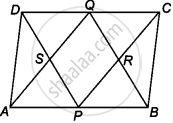
P and Q are the mid-points of the opposite sides AB and CD of a parallelogram ABCD. AQ intersects DP at S and BQ intersects CP at R. Show that PRQS is a parallelogram.
Advertisements
उत्तर
Given: In a parallelogram ABCD, P and Q are the mid-points of AS and CD, respectively.
To show: PRQS is a parallelogram.
Proof: Since, ABCD is a parallelogram.
AB || CD
⇒ AP || QC
Also, AB = DC
`1/2`AB = `1/2`DC ...[Dividing both sides by 2]
⇒ AP = QC ...[Since, P and Q are the mid-points of AB and DC]
Now, AP || QC and AP = QC
Thus, APCQ is a parallelogram.
∴ AQ || PC or SQ || PR ...(i)
Again, AB || DC or BP || DQ
Also, AB = DC
⇒ `1/2`AB = `1/2`DC ...[Dividing both sides by 2]
⇒ BP = QD ...[Since, P and Q are the mid-points of AB and DC]
Now, BP || QD and BP = QD
So, BPDQ is a parallelogram.
∴ PD || BQ or PS || QR ...(ii)
From equations (i) and (ii),
SQ || RP and PS || QR
So, PRQS is a parallelogram.
Hence proved.
APPEARS IN
संबंधित प्रश्न
In a ΔABC, E and F are the mid-points of AC and AB respectively. The altitude AP to BC
intersects FE at Q. Prove that AQ = QP.
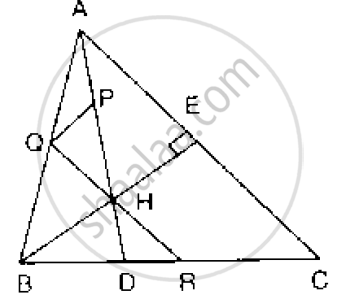
In Fig. below, BE ⊥ AC. AD is any line from A to BC intersecting BE in H. P, Q and R are
respectively the mid-points of AH, AB and BC. Prove that ∠PQR = 90°.
ABCD is a parallelogram, E and F are the mid-points of AB and CD respectively. GH is any line intersecting AD, EF and BC at G, P and H respectively. Prove that GP = PH.
Prove that the figure obtained by joining the mid-points of the adjacent sides of a rectangle is a rhombus.
In the figure, give below, 2AD = AB, P is mid-point of AB, Q is mid-point of DR and PR // BS. Prove that:
(i) AQ // BS
(ii) DS = 3 Rs.

In the given figure, ABCD is a trapezium. P and Q are the midpoints of non-parallel side AD and BC respectively. Find: DC, if AB = 20 cm and PQ = 14 cm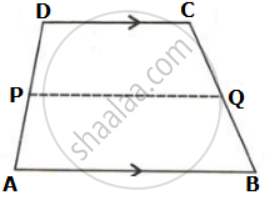
ABCD is a kite in which BC = CD, AB = AD. E, F and G are the mid-points of CD, BC and AB respectively. Prove that: ∠EFG = 90°
D and E are the mid-points of the sides AB and AC of ∆ABC and O is any point on side BC. O is joined to A. If P and Q are the mid-points of OB and OC respectively, then DEQP is ______.
E is the mid-point of the side AD of the trapezium ABCD with AB || DC. A line through E drawn parallel to AB intersect BC at F. Show that F is the mid-point of BC. [Hint: Join AC]
Prove that the line joining the mid-points of the diagonals of a trapezium is parallel to the parallel sides of the trapezium.
