मराठी

In a Right-angled Triangle Abc. ∠Abc = 90° and D is the Midpoint of Ac. Prove that Bd = 1 2 Ac . - Mathematics

Advertisements
Advertisements

प्रश्न

In a right-angled triangle ABC. ∠ABC = 90° and D is the midpoint of AC. Prove that BD = `(1)/(2)"AC"`.

बेरीज
Advertisements

उत्तर
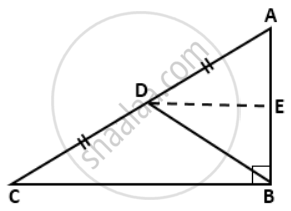

Draw line segment DE || CB, which meets AB at point E.
Now, DE || CB and AB is the transversal,
∴ ∠AED = ∠ABC    ....(corrresponding angles)
∠ABC = 90°             ....(given)
⇒ ∠AED = 90°
Also, as D is the mid-point of AC and DE || CB,
DE bisects side AB,
I.e. AE = BE            ....(i)
In ΔAED and ΔBED,
∠AED = ∠BED      ....(Each 90°)
AE = BE                 ....[From (i)]
DE = DE                ....(Common)
∴ ΔAED ≅ ΔBEd   ....(By SAS Test)
⇒ AD = BD           ....(C.P.C.T.C)
⇒ BD = AC
⇒ BD = `(1)/(2)"AC"`.

shaalaa.com
  या प्रश्नात किंवा उत्तरात काही त्रुटी आहे का?
पाठ 15: Mid-point and Intercept Theorems - Exercise 15.1

APPEARS IN

फ्रँक Mathematics [English] Class 9 ICSE
पाठ 15 Mid-point and Intercept Theorems
Exercise 15.1 | Q 11

संबंधित प्रश्‍न

ABCD is a quadrilateral in which P, Q, R and S are mid-points of the sides AB, BC, CD and DA (see the given figure). AC is a diagonal. Show that:

  1. SR || AC and SR = `1/2AC`
  2. PQ = SR
  3. PQRS is a parallelogram.


In a triangle ∠ABC, ∠A = 50°, ∠B = 60° and ∠C = 70°. Find the measures of the angles of

the triangle formed by joining the mid-points of the sides of this triangle. 


Fill in the blank to make the following statement correct

The triangle formed by joining the mid-points of the sides of an isosceles triangle is         


In parallelogram ABCD, E is the mid-point of AB and AP is parallel to EC which meets DC at point O and BC produced at P.
Prove that:
(i) BP = 2AD
(ii) O is the mid-point of AP.


In parallelogram ABCD, E and F are mid-points of the sides AB and CD respectively. The line segments AF and BF meet the line segments ED and EC at points G and H respectively.
Prove that:
(i) Triangles HEB and FHC are congruent;
(ii) GEHF is a parallelogram.


In ΔABC, D, E, F are the midpoints of BC, CA and AB respectively. Find FE, if BC = 14 cm


In the given figure, ABCD is a trapezium. P and Q are the midpoints of non-parallel side AD and BC respectively. Find: AB, if DC = 8 cm and PQ = 9.5 cm


In the given figure, ABCD is a trapezium. P and Q are the midpoints of non-parallel side AD and BC respectively. Find: DC, if AB = 20 cm and PQ = 14 cm


In ΔABC, D and E are the midpoints of the sides AB and AC respectively. F is any point on the side BC. If DE intersects AF at P show that DP = PE.


The figure formed by joining the mid-points of the sides of a quadrilateral ABCD, taken in order, is a square only if, ______.


Share
Notifications

Englishहिंदीमराठी


      Forgot password?
Use app×