मराठी

L and M are the mid-point of sides AB and DC respectively of parallelogram ABCD. Prove that segments DL and BM trisect diagonal AC

Advertisements
Advertisements

प्रश्न

L and M are the mid-point of sides AB and DC respectively of parallelogram ABCD. Prove that segments DL and BM trisect diagonal AC.

बेरीज
Advertisements

उत्तर

The required figure is shown below
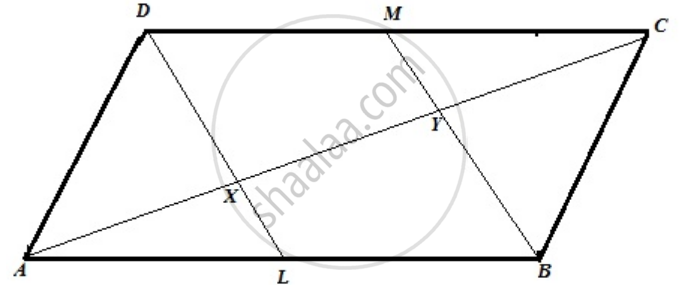
From figure,

BL = DM and BL || DM and BLMD is a parallelogram, therefore BM || DL

From triangle ABY

L is the midpoint of AB and XL || BY, therefore x is the midpoint of AY.ie AX = XY                                    …..(1)

Similarly for triangle CDX
CY=XY                                                …..(2)

From (1) and (2)
AX = XY = CY and AC = AX + XY + CY
Hence proved.

shaalaa.com
  या प्रश्नात किंवा उत्तरात काही त्रुटी आहे का?
पाठ 11: Mid-point Theorem and Its Converse [Including Intercept Theorem] - Exercise 12 (A) [पृष्ठ १५०]

APPEARS IN

सेलिना Concise Mathematics [English] Class 9 ICSE
पाठ 11 Mid-point Theorem and Its Converse [Including Intercept Theorem]
Exercise 12 (A) | Q 7 | पृष्ठ १५०

संबंधित प्रश्‍न

In a triangle ∠ABC, ∠A = 50°, ∠B = 60° and ∠C = 70°. Find the measures of the angles of

the triangle formed by joining the mid-points of the sides of this triangle. 


The diagonals of a quadrilateral intersect at right angles. Prove that the figure obtained by joining the mid-points of the adjacent sides of the quadrilateral is rectangle.


ABCD is a quadrilateral in which AD = BC. E, F, G and H are the mid-points of AB, BD, CD and Ac respectively. Prove that EFGH is a rhombus.


D and F are midpoints of sides AB and AC of a triangle ABC. A line through F and parallel to AB meets BC at point E.

  1. Prove that BDFE is a parallelogram
  2.  Find AB, if EF = 4.8 cm.

D, E, and F are the mid-points of the sides AB, BC, and CA respectively of ΔABC. AE meets DF at O. P and Q are the mid-points of OB and OC respectively. Prove that DPQF is a parallelogram.


In the given figure, ABCD is a trapezium. P and Q are the midpoints of non-parallel side AD and BC respectively. Find: PQ, if AB = 12 cm and DC = 10 cm.


Side AC of a ABC is produced to point E so that CE = `(1)/(2)"AC"`. D is the mid-point of BC and ED produced meets AB at F. Lines through D and C are drawn parallel to AB which meets AC at point P and EF at point R respectively. Prove that: 4CR = AB.


In a parallelogram ABCD, E and F are the midpoints of the sides AB and CD respectively. The line segments AF and BF meet the line segments DE and CE at points G and H respectively Prove that: ΔHEB ≅ ΔHFC


P and Q are the mid-points of the opposite sides AB and CD of a parallelogram ABCD. AQ intersects DP at S and BQ intersects CP at R. Show that PRQS is a parallelogram.


E and F are respectively the mid-points of the non-parallel sides AD and BC of a trapezium ABCD. Prove that EF || AB and EF = `1/2` (AB + CD).

[Hint: Join BE and produce it to meet CD produced at G.]


Share
Notifications

Englishहिंदीमराठी


      Forgot password?
Use app×