Advertisements
Advertisements
प्रश्न
D, E, and F are the mid-points of the sides AB, BC, and CA respectively of ΔABC. AE meets DF at O. P and Q are the mid-points of OB and OC respectively. Prove that DPQF is a parallelogram.
Advertisements
उत्तर
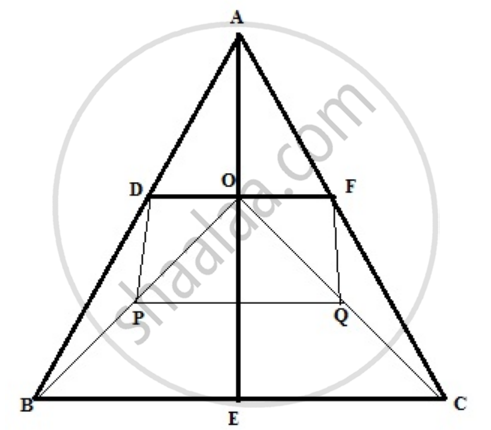
Given: △ABC, D, E, F are midpoints of AB, BC, AC respectively. AB and DF meet at O. P and Q are midpoints of OB and OC respectively.
To Prove: DPFQ is a parallelogram.
Proof:
In △ABC,
D is the mid-point of AB and F is the mid-point of AC
Hence, DF ∥ BC and DF = `1/2`BC ... (1) (Mid-point theorem)
In △OBC,
P is the mid-point of OB and Q is the mid-point of OC
Hence, PQ ∥ BC and PQ = `1/2`BC ... (2) (mid-point theorem)
thus, from (1) and (2)
DF ∥ PQ and DF = PQ ....(3)
Now, In △AOB,
D is the mid-point of AB and P is the mid-point of OB
Thus, DP ∥ AE and DP = `1/2`AE ....(4) (midpoint theorem)
Now, In △AOC,
F is the midpoint of AC and Q is the midpoint of OC
Thus, FQ ∥ AE and QF = `1/2`AE .....(5) (midpoint theorem)
thus, from (4) and (5)
DP ∥ FQ and DP = FQ .....(6)
DPFQ is a parallelogram ......(from (3) and (6))
Hence proved.
APPEARS IN
संबंधित प्रश्न
ABCD is a rhombus and P, Q, R and S are the mid-points of the sides AB, BC, CD and DA respectively. Show that the quadrilateral PQRS is a rectangle.
In the below Fig, ABCD and PQRC are rectangles and Q is the mid-point of Prove thaT
i) DP = PC (ii) PR = `1/2` AC

In ∆ABC, E is the mid-point of the median AD, and BE produced meets side AC at point Q.
Show that BE: EQ = 3: 1.
The diagonals of a quadrilateral intersect at right angles. Prove that the figure obtained by joining the mid-points of the adjacent sides of the quadrilateral is rectangle.
In triangle ABC ; D and E are mid-points of the sides AB and AC respectively. Through E, a straight line is drawn parallel to AB to meet BC at F.
Prove that BDEF is a parallelogram. If AB = 16 cm, AC = 12 cm and BC = 18 cm,
find the perimeter of the parallelogram BDEF.
In a right-angled triangle ABC. ∠ABC = 90° and D is the midpoint of AC. Prove that BD = `(1)/(2)"AC"`.
In the given figure, ABCD is a trapezium. P and Q are the midpoints of non-parallel side AD and BC respectively. Find: PQ, if AB = 12 cm and DC = 10 cm.
In ΔABC, the medians BE and CD are produced to the points P and Q respectively such that BE = EP and CD = DQ. Prove that: Q A and P are collinear.
In the given figure, T is the midpoint of QR. Side PR of ΔPQR is extended to S such that R divides PS in the ratio 2:1. TV and WR are drawn parallel to PQ. Prove that T divides SU in the ratio 2:1 and WR = `(1)/(4)"PQ"`.
P, Q, R and S are respectively the mid-points of sides AB, BC, CD and DA of quadrilateral ABCD in which AC = BD and AC ⊥ BD. Prove that PQRS is a square.
