Advertisements
Advertisements
प्रश्न
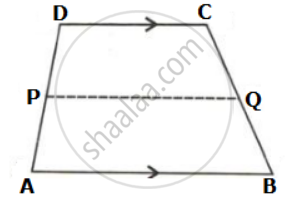
In the given figure, ABCD is a trapezium. P and Q are the midpoints of non-parallel side AD and BC respectively. Find: PQ, if AB = 12 cm and DC = 10 cm.
Advertisements
उत्तर
Let us draw a diagonal AC which meets PQ at O as shown below:
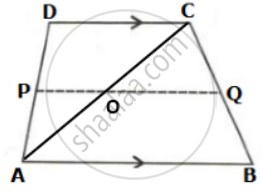
Given AB = 12 cm and DC = 10 cm
In ΔABC,
OQ = `(1)/(2)"AB"` ....(Mid-point Theorem)
⇒ OQ = `(1)/(2) xx 12` = 6 cm
In ΔADC,
OP = `(1)/(2)"DC"` ....(Mid-point Theorem)
⇒ OP = `(1)/(2) xx 10` = 5 cm
Now,
PQ = OP + OQ
= 6 + 5
= 11 cm.
APPEARS IN
संबंधित प्रश्न
In a ΔABC, E and F are the mid-points of AC and AB respectively. The altitude AP to BC
intersects FE at Q. Prove that AQ = QP.
In the below Fig, ABCD and PQRC are rectangles and Q is the mid-point of Prove thaT
i) DP = PC (ii) PR = `1/2` AC

In the adjacent figure, `square`ABCD is a trapezium AB || DC. Points M and N are midpoints of diagonal AC and DB respectively then prove that MN || AB.

In trapezium ABCD, sides AB and DC are parallel to each other. E is mid-point of AD and F is mid-point of BC.
Prove that: AB + DC = 2EF.
In parallelogram ABCD, E is the mid-point of AB and AP is parallel to EC which meets DC at point O and BC produced at P.
Prove that:
(i) BP = 2AD
(ii) O is the mid-point of AP.
Side AC of a ABC is produced to point E so that CE = `(1)/(2)"AC"`. D is the mid-point of BC and ED produced meets AB at F. Lines through D and C are drawn parallel to AB which meets AC at point P and EF at point R respectively. Prove that: 3DF = EF
In ΔABC, D and E are the midpoints of the sides AB and AC respectively. F is any point on the side BC. If DE intersects AF at P show that DP = PE.
In the given figure, PS = 3RS. M is the midpoint of QR. If TR || MN || QP, then prove that:
ST = `(1)/(3)"LS"`
In the given figure, PS = 3RS. M is the midpoint of QR. If TR || MN || QP, then prove that:
RT = `(1)/(3)"PQ"`
P and Q are the mid-points of the opposite sides AB and CD of a parallelogram ABCD. AQ intersects DP at S and BQ intersects CP at R. Show that PRQS is a parallelogram.
