मराठी

In δAbc, D and E Are the Midpoints of the Sides Ab and Ac Respectively. F is Any Point on the Side Bc. If De Intersects Af at P Show that Dp = Pe. - Mathematics

Advertisements
Advertisements

प्रश्न

In ΔABC, D and E are the midpoints of the sides AB and AC respectively. F is any point on the side BC. If DE intersects AF at P show that DP = PE.

बेरीज
Advertisements

उत्तर

Note: This question is incomplete.
According to the information given in the question,
F could be any point on BC as shown below:
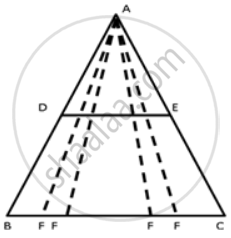
So, this makes it impossible to prove that DP = DE, since P too would shift as F shift because P too would be any point on DE as F is.
Note: If we are given F to be the mid-point of BC, the result can be proved.
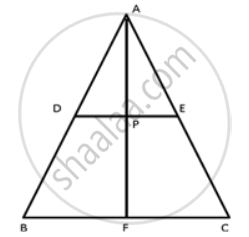
D and E are the mid-points of AB and AC respectively.

DE || BC and DE = `(1)/(2)"BC"`

But F is the mid-point of BC.

⇒ BF = FC = `(1)/(2)"BC"` = DE

Since D is the mid-point of AB, and DP || EF, P is the mid-point of AF.
Since P is the mid-point of AF and E is the mid-point of AC,

PE = `(1)/(2)"FC"`

Also, D and P are the mid-points of AB and AF respectively.

⇒ DP = `(1)/(2)"BF"`

= `(1)/(2)"FC"`

= PE ....(Since BF = FC)
⇒ DP = PE.

shaalaa.com
  या प्रश्नात किंवा उत्तरात काही त्रुटी आहे का?
पाठ 15: Mid-point and Intercept Theorems - Exercise 15.2

APPEARS IN

फ्रँक Mathematics [English] Class 9 ICSE
पाठ 15 Mid-point and Intercept Theorems
Exercise 15.2 | Q 6

संबंधित प्रश्‍न

ABCD is a rectangle and P, Q, R and S are mid-points of the sides AB, BC, CD and DA respectively. Show that the quadrilateral PQRS is a rhombus.


In Fig. below, triangle ABC is right-angled at B. Given that AB = 9 cm, AC = 15 cm and D,
E are the mid-points of the sides AB and AC respectively, calculate
(i) The length of BC (ii) The area of ΔADE.


ABC is a triangle and through A, B, C lines are drawn parallel to BC, CA and AB respectively
intersecting at P, Q and R. Prove that the perimeter of ΔPQR is double the perimeter of
ΔABC


ABCD is a parallelogram, E and F are the mid-points of AB and CD respectively. GH is any line intersecting AD, EF and BC at G, P and H respectively. Prove that GP = PH.


Show that the line segments joining the mid-points of the opposite sides of a quadrilateral
bisect each other.


The side AC of a triangle ABC is produced to point E so that CE = AC. D is the mid-point of BC and ED produced meets AB at F. Lines through D and C are drawn parallel to AB which meet AC at point P and EF at point R respectively.

Prove that:

  1. 3DF = EF
  2. 4CR = AB

In triangle ABC, angle B is obtuse. D and E are mid-points of sides AB and BC respectively and F is a point on side AC such that EF is parallel to AB. Show that BEFD is a parallelogram.


In ΔABC, D, E, F are the midpoints of BC, CA and AB respectively. Find DE, if AB = 8 cm


In the given figure, ABCD is a trapezium. P and Q are the midpoints of non-parallel side AD and BC respectively. Find: DC, if AB = 20 cm and PQ = 14 cm


D, E and F are the mid-points of the sides BC, CA and AB, respectively of an equilateral triangle ABC. Show that ∆DEF is also an equilateral triangle.


Share
Notifications

Englishहिंदीमराठी


      Forgot password?
Use app×