Advertisements
Advertisements
प्रश्न
The figure obtained by joining the mid-points of the sides of a rhombus, taken in order, is ______.
पर्याय
a rhombus
a rectangle
a square
any parallelogram
Advertisements
उत्तर
The figure obtained by joining the mid-points of the sides of a rhombus, taken in order, is a rectangle.
Explanation:
The Midpoint Theorem states that the segment joining two sides of a triangle at the midpoints of those sides is parallel to the third side and is half the length of the third side.
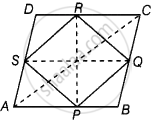
Join AC, RP and SQ
In ∆ABC,
P is midpoint of AB and Q is midpoint of BC
∴ By midpoint theorem,
PQ || AC and PQ = `1/2` AC ...(1)
Similarly,
In ∆DAC,
S is midpoint of AD and R is midpoint of CD
∴ By midpoint theorem,
SR || AC and SR = `1/2` AC ...(2)
From (1) and (2),
PQ || SR and PQ = SR
⇒ PQRS is a parallelogram
ABQS is a parallelogram
⇒ AB = SQ
PBCR is a parallelogram
⇒ BC = PR
⇒ AB = PR ...[∵ BC = AB, sides of rhombus]
⇒ SQ = PR
∴ Diagonals of the parallelogram are equal.
Hence, it is a rectangle.
APPEARS IN
संबंधित प्रश्न
ABCD is a quadrilateral in which P, Q, R and S are mid-points of the sides AB, BC, CD and DA (see the given figure). AC is a diagonal. Show that:
- SR || AC and SR = `1/2AC`
- PQ = SR
- PQRS is a parallelogram.

ABC is a triangle right angled at C. A line through the mid-point M of hypotenuse AB and parallel to BC intersects AC at D. Show that
- D is the mid-point of AC
- MD ⊥ AC
- CM = MA = `1/2AB`
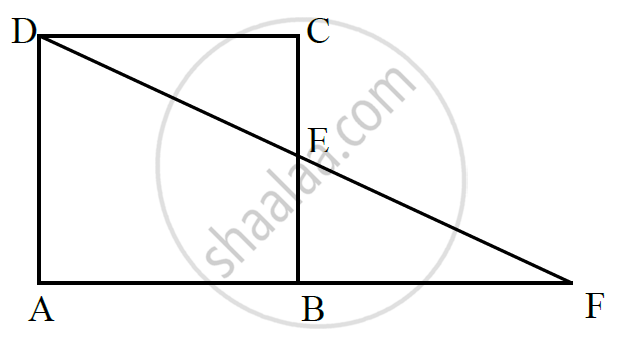
In below fig. ABCD is a parallelogram and E is the mid-point of side B If DE and AB when produced meet at F, prove that AF = 2AB.
ABCD is a square E, F, G and H are points on AB, BC, CD and DA respectively, such that AE = BF = CG = DH. Prove that EFGH is a square.
Fill in the blank to make the following statement correct:
The triangle formed by joining the mid-points of the sides of a right triangle is
In ΔABC, D is the mid-point of AB and E is the mid-point of BC.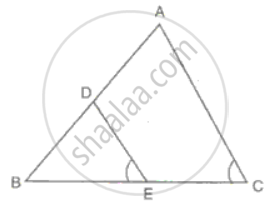
Calculate:
(i) DE, if AC = 8.6 cm
(ii) ∠DEB, if ∠ACB = 72°
In ΔABC, BE and CF are medians. P is a point on BE produced such that BE = EP and Q is a point on CF produced such that CF = FQ. Prove that: QAP is a straight line.
If L and M are the mid-points of AB, and DC respectively of parallelogram ABCD. Prove that segment DL and BM trisect diagonal AC.
The quadrilateral formed by joining the mid-points of the sides of a quadrilateral PQRS, taken in order, is a rectangle, if ______.
E and F are respectively the mid-points of the non-parallel sides AD and BC of a trapezium ABCD. Prove that EF || AB and EF = `1/2` (AB + CD).
[Hint: Join BE and produce it to meet CD produced at G.]
