मराठी

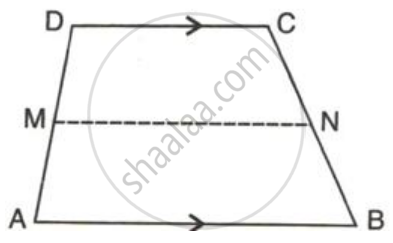
The figure, given below, shows a trapezium ABCD. M and N are the mid-point of the non-parallel sides AD and BC respectively. Find: i. MN, if AB = 11 cm and DC = 8 cm. - Mathematics
Advertisements
Advertisements

प्रश्न

The figure, given below, shows a trapezium ABCD. M and N are the mid-point of the non-parallel sides AD and BC respectively. Find: 

  1. MN, if AB = 11 cm and DC = 8 cm.
  2. AB, if DC = 20 cm and MN = 27 cm.
  3. DC, if MN = 15 cm and AB = 23 cm.
बेरीज
Advertisements

उत्तर

Let we draw a diagonal AC as shown in the figure below,

(i) Given that AB = 11 cm, CD = 8 cm

From triangle ABC

ON = `[1]/[2]` AB

= `[1]/[2]` × 11

= 5.5 cm

From triangle ACD

OM = `[1]/[2]` CD

=`[1]/[2]` × 8

= 4 cm

Hence, MN = OM + ON

= (4 + 5.5)

= 9.5 cm

(ii) Given that CD = 20 cm, MN = 27 cm

From triangle ACD

OM = `[1]/[2]` CD

= `[1]/[2]` × 20

= 10 cm

Therefore, ON = 27 - 10 = 17 cm

From triangle ABC

AB = 2ON

= 2 × 17

= 34 cm

(iii) Given that AB = 23 cm, MN = 15 cm

From triangle ABC

ON =`[1]/[2]` AB

=`[1]/[2]` × 23

= 11.5 cm

OM = 15 - 11.5

OM = 3.5 cm

From triangle ACD

CD = 2OM

= 2 × 3.5

CD = 7 cm

shaalaa.com
  या प्रश्नात किंवा उत्तरात काही त्रुटी आहे का?
पाठ 12: Mid-point and Its Converse [ Including Intercept Theorem] - Exercise 12 (A) [पृष्ठ १५०]

APPEARS IN

सेलिना Concise Mathematics [English] Class 9 ICSE
पाठ 12 Mid-point and Its Converse [ Including Intercept Theorem]
Exercise 12 (A) | Q 5 | पृष्ठ १५०

संबंधित प्रश्‍न

Show that the line segments joining the mid-points of the opposite sides of a quadrilateral bisect each other.


ABC is a triangle right angled at C. A line through the mid-point M of hypotenuse AB and parallel to BC intersects AC at D. Show that

  1. D is the mid-point of AC
  2. MD ⊥ AC
  3. CM = MA = `1/2AB`

In the given figure, points X, Y, Z are the midpoints of side AB, side BC and side AC of ΔABC respectively. AB = 5 cm, AC = 9 cm and BC = 11 cm. Find the length of XY, YZ, XZ.


In the given figure, seg PD is a median of ΔPQR. Point T is the mid point of seg PD. Produced QT intersects PR at M. Show that `"PM"/"PR" = 1/3`.

[Hint: DN || QM]


A parallelogram ABCD has P the mid-point of Dc and Q a point of Ac such that

CQ = `[1]/[4]`AC. PQ produced meets BC at R.

Prove that
(i)R is the midpoint of BC
(ii) PR = `[1]/[2]` DB


The diagonals of a quadrilateral intersect each other at right angle. Prove that the figure obtained by joining the mid-points of the adjacent sides of the quadrilateral is a rectangle.


In the given figure, ABCD is a trapezium. P and Q are the midpoints of non-parallel side AD and BC respectively. Find: AB, if DC = 8 cm and PQ = 9.5 cm


In ΔABC, X is the mid-point of AB, and Y is the mid-point of AC. BY and CX are produced and meet the straight line through A parallel to BC at P and Q respectively. Prove AP = AQ.


In the given figure, T is the midpoint of QR. Side PR of ΔPQR is extended to S such that R divides PS in the ratio 2:1. TV and WR are drawn parallel to PQ. Prove that T divides SU in the ratio 2:1 and WR = `(1)/(4)"PQ"`.


P and Q are the mid-points of the opposite sides AB and CD of a parallelogram ABCD. AQ intersects DP at S and BQ intersects CP at R. Show that PRQS is a parallelogram.


Share
Notifications

Englishहिंदीमराठी


      Forgot password?
Use app×