मराठी

In δAbc, P is the Mid-point of Bc. a Line Through P and Parallel to Ca Meets Ab at Point Q, and a Line Through Q and Parallel to Bc Meets Median Ap at Point R. Prove That: Ap = 2ar

Advertisements
Advertisements

प्रश्न

In ΔABC, P is the mid-point of BC. A line through P and parallel to CA meets AB at point Q, and a line through Q and parallel to BC meets median AP at point R. Prove that: AP = 2AR

बेरीज
Advertisements

उत्तर
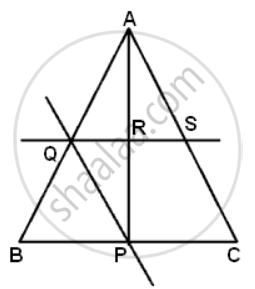

In ΔABC,
P is the mid-point of BC and PQ is parallel to AC
Therefore, Q is the mid-point of AB.
In ΔABP,
Q is the mid-point of AB and QR is parallel to BP
Therefore, R is the mid-point of AP.
AR = RP
But AR + RP = AP
⇒ AR + AR = AP
⇒ 2AR = AP or AP = 2AR.

shaalaa.com
  या प्रश्नात किंवा उत्तरात काही त्रुटी आहे का?
पाठ 15: Mid-point and Intercept Theorems - Exercise 15.1

APPEARS IN

फ्रँक Mathematics [English] Class 9 ICSE
पाठ 15 Mid-point and Intercept Theorems
Exercise 15.1 | Q 16.1

संबंधित प्रश्‍न

Show that the line segments joining the mid-points of the opposite sides of a quadrilateral bisect each other.


In a triangle, P, Q and R are the mid-points of sides BC, CA and AB respectively. If AC =
21 cm, BC = 29 cm and AB = 30 cm, find the perimeter of the quadrilateral ARPQ.


Let Abc Be an Isosceles Triangle in Which Ab = Ac. If D, E, F Be the Mid-points of the Sides Bc, Ca and a B Respectively, Show that the Segment Ad and Ef Bisect Each Other at Right Angles.


BM and CN are perpendiculars to a line passing through the vertex A of a triangle ABC. If
L is the mid-point of BC, prove that LM = LN.


The following figure shows a trapezium ABCD in which AB // DC. P is the mid-point of AD and PR // AB. Prove that:

PR = `[1]/[2]` ( AB + CD)


In trapezium ABCD, AB is parallel to DC; P and Q are the mid-points of AD and BC respectively. BP produced meets CD produced at point E.

Prove that:

  1. Point P bisects BE,
  2. PQ is parallel to AB.

In triangle ABC, the medians BP and CQ are produced up to points M and N respectively such that BP = PM and CQ = QN. Prove that:

  1. M, A, and N are collinear.
  2. A is the mid-point of MN.

In ΔABC, D, E, F are the midpoints of BC, CA and AB respectively. Find ∠FDB if ∠ACB = 115°.


In parallelogram ABCD, P is the mid-point of DC. Q is a point on AC such that CQ = `(1)/(4)"AC"`. PQ produced meets BC at R. Prove that

(i) R is the mid-point of BC, and

(ii) PR = `(1)/(2)"DB"`.


In the given figure, ABCD is a trapezium. P and Q are the midpoints of non-parallel side AD and BC respectively. Find: DC, if AB = 20 cm and PQ = 14 cm


Share
Notifications

Englishहिंदीमराठी


      Forgot password?
Use app×