Advertisements
Advertisements
प्रश्न
D and E are the mid-points of the sides AB and AC of ∆ABC and O is any point on side BC. O is joined to A. If P and Q are the mid-points of OB and OC respectively, then DEQP is ______.
पर्याय
a square
a rectangle
a rhombus
a parallelogram
Advertisements
उत्तर
D and E are the mid-points of the sides AB and AC of ∆ABC and O is any point on side BC. O is joined to A. If P and Q are the mid-points of OB and OC respectively, then DEQP is a parallelogram.
Explanation:

In ΔABC, D and E are the mid-points of sides AB and AC, respectively.
By mid-point theorem,
DE || BC ...(i)
DE = `1/2` BC
Then, DE = `1/2` [BP + PO + OQ + QC]
DE = `1/2` [2PO + 2OQ] ...[Since, P and Q are the mid-points of OB and OC respectively]
⇒ DE = PO + OQ
⇒ DE = PQ
Now, in ΔAOC, Q and E are the mid-points of OC and AC respectively.
∴ EQ || AO and EQ = `1/2` AO [By mid-point theorem] ...(iii)
Similarly, in ΔABO,
PD || AO and PD = `1/2` AO [By mid-point theorem] ...(iv)
From equations (iii) and (iv),
EQ || PD and EQ = PD
From equations (i) and (ii),
DE || BC (or DE || PQ) and DE = PQ
Hence, DEQP is a parallelogram.
APPEARS IN
संबंधित प्रश्न
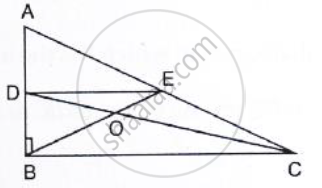
In Fig. below, triangle ABC is right-angled at B. Given that AB = 9 cm, AC = 15 cm and D,
E are the mid-points of the sides AB and AC respectively, calculate
(i) The length of BC (ii) The area of ΔADE.
ABCD is a parallelogram, E and F are the mid-points of AB and CD respectively. GH is any line intersecting AD, EF and BC at G, P and H respectively. Prove that GP = PH.
In ∆ABC, E is the mid-point of the median AD, and BE produced meets side AC at point Q.
Show that BE: EQ = 3: 1.
In ΔABC, BE and CF are medians. P is a point on BE produced such that BE = EP and Q is a point on CF produced such that CF = FQ. Prove that: A is the mid-point of PQ.
D, E and F are the mid-points of the sides AB, BC and CA of an isosceles ΔABC in which AB = BC. Prove that ΔDEF is also isosceles.
The diagonals of a quadrilateral intersect each other at right angle. Prove that the figure obtained by joining the mid-points of the adjacent sides of the quadrilateral is a rectangle.
In ΔABC, P is the mid-point of BC. A line through P and parallel to CA meets AB at point Q, and a line through Q and parallel to BC meets median AP at point R. Prove that: BC = 4QR
In ΔABC, D and E are the midpoints of the sides AB and BC respectively. F is any point on the side AC. Also, EF is parallel to AB. Prove that BFED is a parallelogram.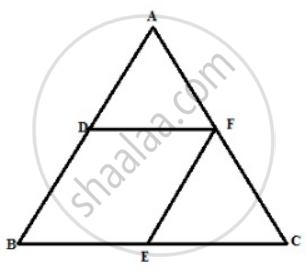
Remark: Figure is incorrect in Question
P, Q, R and S are respectively the mid-points of the sides AB, BC, CD and DA of a quadrilateral ABCD such that AC ⊥ BD. Prove that PQRS is a rectangle.
Show that the quadrilateral formed by joining the mid-points of the consecutive sides of a square is also a square.
