Advertisements
Advertisements
प्रश्न
The figure formed by joining the mid-points of the sides of a quadrilateral ABCD, taken in order, is a square only if, ______.
पर्याय
ABCD is a rhombus
diagonals of ABCD are equal
diagonals of ABCD are equal and perpendicular
diagonals of ABCD are perpendicular
Advertisements
उत्तर
The figure formed by joining the mid-points of the sides of a quadrilateral ABCD, taken in order, is a square only if, diagonals of ABCD are equal and perpendicular.
Explanation:
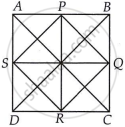
Given, ABCD is a quadrilateral and P, Q, R and S are the mid-points of sides of AB, BC, CD and DA, respectively.
Then, PQRS is a square.
∴ PQ = QR = RS = PS ...(i)
And PR = SQ
But PR = BC and SQ = AB
∴ AB = BC
Thus, all the sides of quadrilateral ABCD are equal.
Hence, quadrilateral ABCD is either a square or a rhombus.
Now, in ΔADB, use mid-point theorem
SP || DB
And SP = `1/2` DB ...(ii)
Similarly in ΔABC ...(By mid-point theorem)
PQ || AC and PQ = `1/2` AC ...(iii)
From equation (i),
PS = PQ
⇒ `1/2` DB = `1/2` AC ...[From equations (ii) and (iii)]
⇒ DB = AC
Thus, diagonals of ABCD are equal and therefore quadrilateral ABCD is a square not rhombus. So, diagonals of quadrilateral are also perpendicular.
APPEARS IN
संबंधित प्रश्न
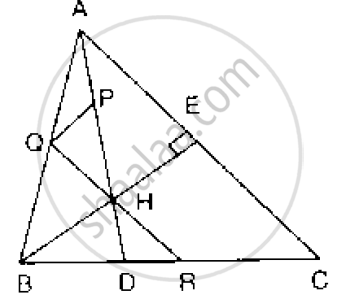
In Fig. below, BE ⊥ AC. AD is any line from A to BC intersecting BE in H. P, Q and R are
respectively the mid-points of AH, AB and BC. Prove that ∠PQR = 90°.
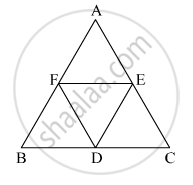
In the given figure, ΔABC is an equilateral traingle. Points F, D and E are midpoints of side AB, side BC, side AC respectively. Show that ΔFED is an equilateral traingle.
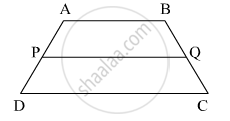
In the Figure, `square`ABCD is a trapezium. AB || DC. Points P and Q are midpoints of seg AD and seg BC respectively. Then prove that, PQ || AB and PQ = `1/2 ("AB" + "DC")`.
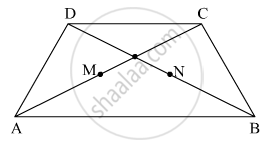
In the adjacent figure, `square`ABCD is a trapezium AB || DC. Points M and N are midpoints of diagonal AC and DB respectively then prove that MN || AB.
D, E, and F are the mid-points of the sides AB, BC and CA of an isosceles ΔABC in which AB = BC.
Prove that ΔDEF is also isosceles.
In a right-angled triangle ABC. ∠ABC = 90° and D is the midpoint of AC. Prove that BD = `(1)/(2)"AC"`.
ABCD is a parallelogram.E is the mid-point of CD and P is a point on AC such that PC = `(1)/(4)"AC"`. EP produced meets BC at F. Prove that: 2EF = BD.
In the given figure, PS = 3RS. M is the midpoint of QR. If TR || MN || QP, then prove that: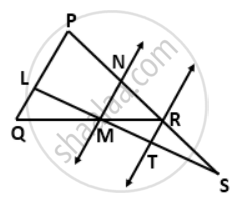
RT = `(1)/(3)"PQ"`
The figure obtained by joining the mid-points of the sides of a rhombus, taken in order, is ______.
E is the mid-point of a median AD of ∆ABC and BE is produced to meet AC at F. Show that AF = `1/3` AC.
