Advertisements
Advertisements
प्रश्न
ABCD is a rhombus and P, Q, R and S are the mid-points of the sides AB, BC, CD and DA respectively. Show that the quadrilateral PQRS is a rectangle.
Advertisements
उत्तर
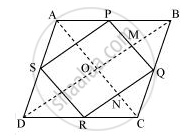
In ΔABC, P and Q are the mid-points of sides AB and BC respectively.
∴ PQ || AC and PQ = `1/2 AC` ...(Using mid-point theorem) ...(1)
In ΔADC,
R and S are the mid-points of CD and AD respectively.
∴ RS || AC and RS = `1/2 AC` ...(Using mid-point theorem) ...(2)
From equations (1) and (2), we obtain
PQ || RS and PQ = RS
Since in quadrilateral PQRS, one pair of opposite sides is equal and parallel to each other, it is a parallelogram.
Let the diagonals of rhombus ABCD intersect each other at point O.
In quadrilateral OMQN,
MQ || ON ...(∵ PQ || AC)
QN || OM ...(∵ QR || BD)
Therefore, OMQN is a parallelogram.
⇒ ∠MQN = ∠NOM
⇒ ∠PQR = ∠NOM
However, ∠NOM = 90° ...(Diagonals of a rhombus are perpendicular to each other)
∴ ∠PQR = 90°
Clearly, PQRS is a parallelogram having one of its interior angles as 90°.
Hence, PQRS is a rectangle.
APPEARS IN
संबंधित प्रश्न
In a ΔABC, BM and CN are perpendiculars from B and C respectively on any line passing
through A. If L is the mid-point of BC, prove that ML = NL.
ABCD is a kite having AB = AD and BC = CD. Prove that the figure formed by joining the
mid-points of the sides, in order, is a rectangle.
Fill in the blank to make the following statement correct:
The triangle formed by joining the mid-points of the sides of a right triangle is
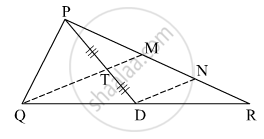
In the given figure, seg PD is a median of ΔPQR. Point T is the mid point of seg PD. Produced QT intersects PR at M. Show that `"PM"/"PR" = 1/3`.
[Hint: DN || QM]
The following figure shows a trapezium ABCD in which AB // DC. P is the mid-point of AD and PR // AB. Prove that:
PR = `[1]/[2]` ( AB + CD)

In ΔABC, AB = 12 cm and AC = 9 cm. If M is the mid-point of AB and a straight line through M parallel to AC cuts BC in N, what is the length of MN?
In ΔABC, the medians BE and CD are produced to the points P and Q respectively such that BE = EP and CD = DQ. Prove that: Q A and P are collinear.
In ΔABC, D and E are the midpoints of the sides AB and AC respectively. F is any point on the side BC. If DE intersects AF at P show that DP = PE.
In ∆ABC, AB = 5 cm, BC = 8 cm and CA = 7 cm. If D and E are respectively the mid-points of AB and BC, determine the length of DE.
Show that the quadrilateral formed by joining the mid-points of the consecutive sides of a square is also a square.
