Advertisements
Advertisements
प्रश्न
E and F are respectively the mid-points of the non-parallel sides AD and BC of a trapezium ABCD. Prove that EF || AB and EF = `1/2` (AB + CD).
[Hint: Join BE and produce it to meet CD produced at G.]
Advertisements
उत्तर
Given: ABCD is a trapezium in which AB || CD. Also, E and F are respectively the mid-points of sides AD and BC.
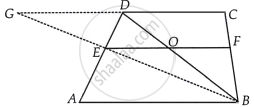
Construction: Join BE and produce it to meet CD produced at G, also draw BD which intersects EF at O.
To prove: EF || AB and EF = `1/2` (AB + CD).
Proof: In ΔGCB, E and F are respectively the mid-points of BG and BC, then by mid-point theorem,
EF || GC
But GC || AB or CD || AB ...[Given]
∴ EF || AB
In ΔADB, AB || EO and E is the mid-point of AD.
Therefore by converse of mid-point theorem, O is mid-point of BD.
Also, EO = `1/2` AB ...(i)
In ΔBDC, OF || CD and O is the mid-point of BD.
∴ OF = `1/2` CD [By converse of mid-point theorem] ...(ii)
On adding equations (i) and (ii), we get
EO + OF = `1/2` AB + `1/2` CD
⇒ EF = `1/2` (AB + CD)
Hence proved.
APPEARS IN
संबंधित प्रश्न
In a ΔABC, E and F are the mid-points of AC and AB respectively. The altitude AP to BC
intersects FE at Q. Prove that AQ = QP.
ABC is a triangle and through A, B, C lines are drawn parallel to BC, CA and AB respectively
intersecting at P, Q and R. Prove that the perimeter of ΔPQR is double the perimeter of
ΔABC
A parallelogram ABCD has P the mid-point of Dc and Q a point of Ac such that
CQ = `[1]/[4]`AC. PQ produced meets BC at R.

Prove that
(i)R is the midpoint of BC
(ii) PR = `[1]/[2]` DB
In triangle ABC, the medians BP and CQ are produced up to points M and N respectively such that BP = PM and CQ = QN. Prove that:
- M, A, and N are collinear.
- A is the mid-point of MN.
In parallelogram ABCD, E is the mid-point of AB and AP is parallel to EC which meets DC at point O and BC produced at P.
Prove that:
(i) BP = 2AD
(ii) O is the mid-point of AP.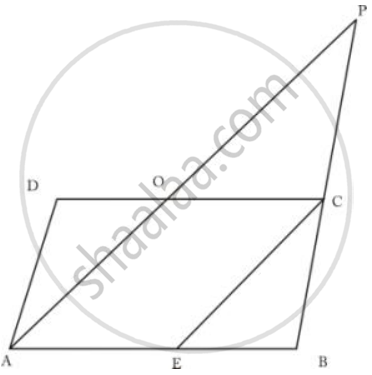
In triangle ABC; M is mid-point of AB, N is mid-point of AC and D is any point in base BC. Use the intercept Theorem to show that MN bisects AD.
In ΔABC, BE and CF are medians. P is a point on BE produced such that BE = EP and Q is a point on CF produced such that CF = FQ. Prove that: A is the mid-point of PQ.
Prove that the figure obtained by joining the mid-points of the adjacent sides of a rectangle is a rhombus.
In ΔABC, P is the mid-point of BC. A line through P and parallel to CA meets AB at point Q, and a line through Q and parallel to BC meets median AP at point R. Prove that: AP = 2AR
Prove that the line joining the mid-points of the diagonals of a trapezium is parallel to the parallel sides of the trapezium.
