Advertisements
Advertisements
Question
E and F are respectively the mid-points of the non-parallel sides AD and BC of a trapezium ABCD. Prove that EF || AB and EF = `1/2` (AB + CD).
[Hint: Join BE and produce it to meet CD produced at G.]
Advertisements
Solution
Given: ABCD is a trapezium in which AB || CD. Also, E and F are respectively the mid-points of sides AD and BC.
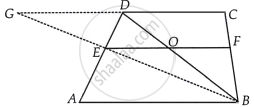
Construction: Join BE and produce it to meet CD produced at G, also draw BD which intersects EF at O.
To prove: EF || AB and EF = `1/2` (AB + CD).
Proof: In ΔGCB, E and F are respectively the mid-points of BG and BC, then by mid-point theorem,
EF || GC
But GC || AB or CD || AB ...[Given]
∴ EF || AB
In ΔADB, AB || EO and E is the mid-point of AD.
Therefore by converse of mid-point theorem, O is mid-point of BD.
Also, EO = `1/2` AB ...(i)
In ΔBDC, OF || CD and O is the mid-point of BD.
∴ OF = `1/2` CD [By converse of mid-point theorem] ...(ii)
On adding equations (i) and (ii), we get
EO + OF = `1/2` AB + `1/2` CD
⇒ EF = `1/2` (AB + CD)
Hence proved.
APPEARS IN
RELATED QUESTIONS
Let Abc Be an Isosceles Triangle in Which Ab = Ac. If D, E, F Be the Mid-points of the Sides Bc, Ca and a B Respectively, Show that the Segment Ad and Ef Bisect Each Other at Right Angles.
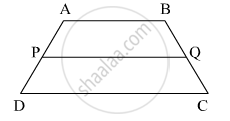
In the Figure, `square`ABCD is a trapezium. AB || DC. Points P and Q are midpoints of seg AD and seg BC respectively. Then prove that, PQ || AB and PQ = `1/2 ("AB" + "DC")`.
In a right-angled triangle ABC. ∠ABC = 90° and D is the midpoint of AC. Prove that BD = `(1)/(2)"AC"`.
ABCD is a parallelogram.E is the mid-point of CD and P is a point on AC such that PC = `(1)/(4)"AC"`. EP produced meets BC at F. Prove that: F is the mid-point of BC.
In a parallelogram ABCD, E and F are the midpoints of the sides AB and CD respectively. The line segments AF and BF meet the line segments DE and CE at points G and H respectively Prove that: ΔHEB ≅ ΔHFC
In ΔABC, the medians BE and CD are produced to the points P and Q respectively such that BE = EP and CD = DQ. Prove that: Q A and P are collinear.
In the given figure, PS = 3RS. M is the midpoint of QR. If TR || MN || QP, then prove that: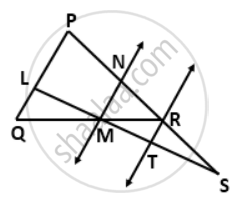
ST = `(1)/(3)"LS"`
The quadrilateral formed by joining the mid-points of the sides of a quadrilateral PQRS, taken in order, is a rectangle, if ______.
D and E are the mid-points of the sides AB and AC of ∆ABC and O is any point on side BC. O is joined to A. If P and Q are the mid-points of OB and OC respectively, then DEQP is ______.
E is the mid-point of a median AD of ∆ABC and BE is produced to meet AC at F. Show that AF = `1/3` AC.
