English

If the Quadrilateral Formed by Joining the Mid-points of the Adjacent Sides of Quadrilateral Abcd is a Rectangle, Show that the Diagonals Ac and Bd Intersect at Right Angle. - Mathematics

Advertisements
Advertisements

Question

If the quadrilateral formed by joining the mid-points of the adjacent sides of quadrilateral ABCD is a rectangle,
show that the diagonals AC and BD intersect at the right angle.

Sum
Advertisements

Solution

The figure is shown below
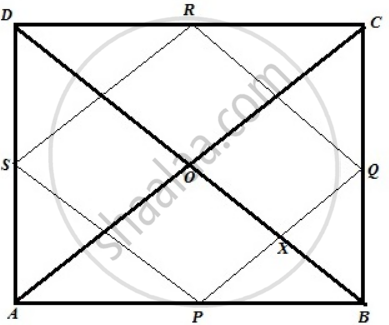
Let ABCD be a quadrilateral where P, Q, R, S are the midpoint of AB, BC, CD, DA.PQRS is a rectangle. Diagonal AC and BD intersect at point O. We need to show that AC and BD intersect at a right angle.

Proof:
PQ || AC, therefore ∠AOD = ∠PXO     ...[ Corresponding angle ]...(1)

Again BD || RQ, therefore ∠PXO = ∠RQX = 90°  ....[ Corresponding angle and angle of a rectangle ]...(2)

From (1) and (2) we get ,
∠AOD = 90°

Similarly, ∠AOB = ∠BOC = ∠DOC = 90°
Therefore diagonals AC and BD intersect at right angle.
Hence proved.

shaalaa.com
  Is there an error in this question or solution?
Chapter 12: Mid-point and Its Converse [ Including Intercept Theorem] - Exercise 12 (B) [Page 154]

APPEARS IN

Selina Concise Mathematics [English] Class 9 ICSE
Chapter 12 Mid-point and Its Converse [ Including Intercept Theorem]
Exercise 12 (B) | Q 9 | Page 154

RELATED QUESTIONS

ABCD is a rectangle and P, Q, R and S are mid-points of the sides AB, BC, CD and DA respectively. Show that the quadrilateral PQRS is a rhombus.


In the Figure, `square`ABCD is a trapezium. AB || DC. Points P and Q are midpoints of seg AD and seg BC respectively. Then prove that, PQ || AB and PQ = `1/2 ("AB" + "DC")`.


The figure, given below, shows a trapezium ABCD. M and N are the mid-point of the non-parallel sides AD and BC respectively. Find: 

  1. MN, if AB = 11 cm and DC = 8 cm.
  2. AB, if DC = 20 cm and MN = 27 cm.
  3. DC, if MN = 15 cm and AB = 23 cm.

In triangle ABC, AD is the median and DE, drawn parallel to side BA, meets AC at point E.
Show that BE is also a median.


In triangle ABC, P is the mid-point of side BC. A line through P and parallel to CA meets AB at point Q, and a line through Q and parallel to BC meets median AP at point R.
Prove that : (i) AP = 2AR
                   (ii) BC = 4QR


In ΔABC, D is the mid-point of AB and E is the mid-point of BC.

Calculate:
(i) DE, if AC = 8.6 cm
(ii) ∠DEB, if ∠ACB = 72°


In ΔABC, P is the mid-point of BC. A line through P and parallel to CA meets AB at point Q, and a line through Q and parallel to BC meets median AP at point R. Prove that: BC = 4QR


In ΔABC, D, E and F are the midpoints of AB, BC and AC.
If AE and DF intersect at G, and M and N are the midpoints of GB and GC respectively, prove that DMNF is a parallelogram.


In ΔABC, the medians BE and CD are produced to the points P and Q respectively such that BE = EP and CD = DQ. Prove that: Q A and P are collinear.


P, Q, R and S are respectively the mid-points of sides AB, BC, CD and DA of quadrilateral ABCD in which AC = BD and AC ⊥ BD. Prove that PQRS is a square.


Share
Notifications

Englishहिंदीमराठी


      Forgot password?
Use app×