Advertisements
Advertisements
Question
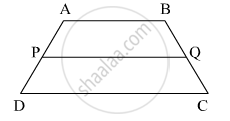
In the Figure, `square`ABCD is a trapezium. AB || DC. Points P and Q are midpoints of seg AD and seg BC respectively. Then prove that, PQ || AB and PQ = `1/2 ("AB" + "DC")`.
Advertisements
Solution

Given: `square`ABCD is a trapezium.
To prove: PQ || AB and PQ = `1/2`(AB + DC)
Construction: Extend line AQ in such a way that, on extending side DC, intersect it at point R.
Proof:
seg AB || seg DC ...(Given)
and seg BC is their transversal.
∴ ∠ABC ≅ ∠RCB ...(Alternate angles)
∴ ∠ABQ ≅ ∠RCQ ...(i) ...(B-Q-C)
In ∆ABQ and ∆RCQ,
∠ABQ ≅∠RCQ ...[From (i)]
seg BQ ≅ seg CQ ...(Q is the midpoint of seg BC)
∠BQA ≅ ∠CQR ...(Vertically opposite angles)
∴ ∆ABQ ≅ ∆RCQ ...(ASA test)
seg AB ≅ seg CR ...(c.s.c.t.) ...(ii)
seg AQ ≅ seg RQ ...(c.s.c.t.) ...(iii)
In ∆ADR,
Point P is the midpoint of line AD. ...(Given)
Point Q is the midpoint of line AR. ...[From (iii)]
∴ seg PQ || side DR ...(Midpoint Theorem)
∴ seg PQ || side DC ...(iv) ...(D-C-R)
∴ side AB || side DC ...(v) ...(Given)
∴ seg PQ || side AB ...[From (iv) and (v)]
PQ = `1/2` DR ...(Midpoint Theorem)
= `1/2` (DC + CR)
= `1/2` (DC + AB) ...[From (ii)]
∴ PQ = `1/2` (AB + DC)
APPEARS IN
RELATED QUESTIONS
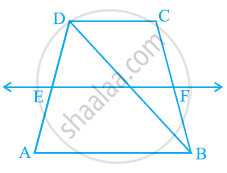
ABCD is a trapezium in which AB || DC, BD is a diagonal and E is the mid-point of AD. A line is drawn through E parallel to AB intersecting BC at F (see the given figure). Show that F is the mid-point of BC.
In a ΔABC, E and F are the mid-points of AC and AB respectively. The altitude AP to BC
intersects FE at Q. Prove that AQ = QP.
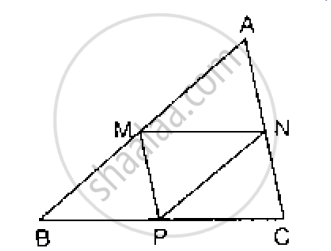
In Fig. below, M, N and P are the mid-points of AB, AC and BC respectively. If MN = 3 cm, NP = 3.5 cm and MP = 2.5 cm, calculate BC, AB and AC.
Show that the line segments joining the mid-points of the opposite sides of a quadrilateral
bisect each other.
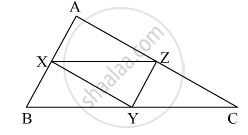
In the given figure, points X, Y, Z are the midpoints of side AB, side BC and side AC of ΔABC respectively. AB = 5 cm, AC = 9 cm and BC = 11 cm. Find the length of XY, YZ, XZ.
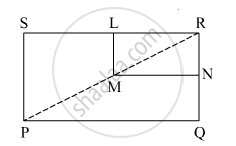
In the given figure, `square`PQRS and `square`MNRL are rectangles. If point M is the midpoint of side PR then prove that,
- SL = LR
- LN = `1/2`SQ
D, E, and F are the mid-points of the sides AB, BC and CA of an isosceles ΔABC in which AB = BC.
Prove that ΔDEF is also isosceles.
In a triangle ABC, AD is a median and E is mid-point of median AD. A line through B and E meets AC at point F.
Prove that: AC = 3AF.
In the given figure, AD and CE are medians and DF // CE.
Prove that: FB = `1/4` AB.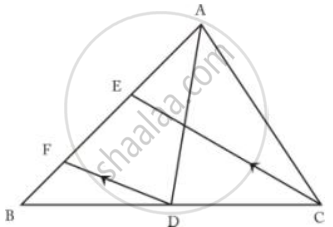
In triangle ABC; M is mid-point of AB, N is mid-point of AC and D is any point in base BC. Use the intercept Theorem to show that MN bisects AD.
In parallelogram PQRS, L is mid-point of side SR and SN is drawn parallel to LQ which meets RQ produced at N and cuts side PQ at M. Prove that M is the mid-point of PQ.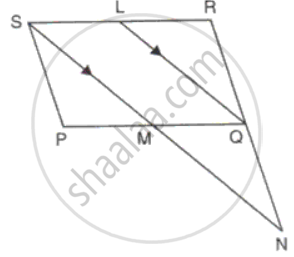
In ΔABC, BE and CF are medians. P is a point on BE produced such that BE = EP and Q is a point on CF produced such that CF = FQ. Prove that: A is the mid-point of PQ.
The diagonals of a quadrilateral intersect each other at right angle. Prove that the figure obtained by joining the mid-points of the adjacent sides of the quadrilateral is a rectangle.
Side AC of a ABC is produced to point E so that CE = `(1)/(2)"AC"`. D is the mid-point of BC and ED produced meets AB at F. Lines through D and C are drawn parallel to AB which meets AC at point P and EF at point R respectively. Prove that: 4CR = AB.
In AABC, D and E are two points on the side AB such that AD = DE = EB. Through D and E, lines are drawn parallel to BC which meet the side AC at points F and G respectively. Through F and G, lines are drawn parallel to AB which meet the side BC at points M and N respectively. Prove that BM = MN = NC.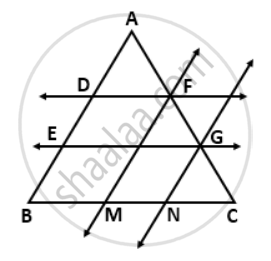
The quadrilateral formed by joining the mid-points of the sides of a quadrilateral PQRS, taken in order, is a rectangle, if ______.
In ∆ABC, AB = 5 cm, BC = 8 cm and CA = 7 cm. If D and E are respectively the mid-points of AB and BC, determine the length of DE.
P, Q, R and S are respectively the mid-points of sides AB, BC, CD and DA of quadrilateral ABCD in which AC = BD and AC ⊥ BD. Prove that PQRS is a square.
E is the mid-point of a median AD of ∆ABC and BE is produced to meet AC at F. Show that AF = `1/3` AC.
