Advertisements
Advertisements
Question
ABCD is a kite having AB = AD and BC = CD. Prove that the figure formed by joining the
mid-points of the sides, in order, is a rectangle.
Advertisements
Solution
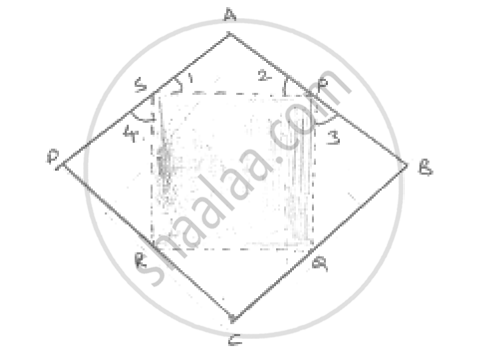
Given,
A kite ABCD having AB = AD and BC = CD. P,Q,R, S are the midpoint of sides
AB,BC,CD andDArespectively PQ,QR,RS and spare joined
To prove:
PQRS is a rectangle
Proof:
In ΔABC, P and Q are the midpoints of AB and BC respectively.
∴PQ || AC and PQ = `1/2` AC ....(i )
In Δ ADC, R and S are the midpoint of CD and AD respectively.
∴ RS || AC and RS = `1/2` AC .....(ii )
From (i) and (ii), we have
PQ || RS and PQ = RS
Thus, in quadrilateral PQRS, a pair of opposite sides are equal and parallel. So PQRS is a
parallelogram. Now, we shall prove that one angle of parallelogram PQRS it is a right angle
Since AB = AD
⇒ `1/2` AB = AD `(1/2)`
⇒ AP = AS ...(iii) [∵ P and S are the midpoints of B and AD respectively]
⇒ `∠`1 = `∠`2 ....(iv)
Now, in ΔPBQ and ΔSDR, we have
PB = SD [ ∴AD = AB ⇒ `1/2` AD = `1/2` AB ]
BQ = DR ∴ PB = SD
And PQ = SR [ ∴ PQRS is a parallelogram]
So by SSS criterion of congruence, we have
Δ PBQ ≅ Δ SOR
⇒ `∠`3 = `∠`4 [CPCT ]
Now, `∠`3 + `∠`SPQ + `∠`2 = 180°
And `∠`1+ `∠`PSR + `∠`4 =180°
∴ `∠`3 + `∠`SPQ + `∠`2 = `∠`1+ `∠`PSR + `∠`4
⇒ `∠`SPQ = `∠`PSR (`∠`1 = `∠`2 and `∠`3 = `∠`4)
Now, transversal PS cuts parallel lines SR and PQ at S and P respectively.
∴ `∠`SPQ + `∠`PSR = 180°
⇒ 2`∠`SPQ = 180° = `∠`SPQ = 90° [ ∵ `∠`PSR = `∠`SPQ]
Thus, PQRS is a parallelogram such that `∠`SPQ = 90°
Hence, PQRS is a parallelogram.
APPEARS IN
RELATED QUESTIONS
Show that the line segments joining the mid-points of the opposite sides of a quadrilateral bisect each other.
In the below Fig, ABCD and PQRC are rectangles and Q is the mid-point of Prove thaT
i) DP = PC (ii) PR = `1/2` AC
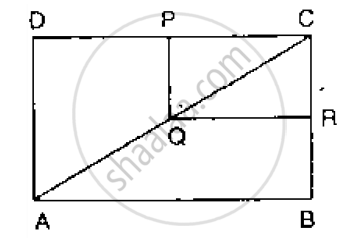
Prove that the figure obtained by joining the mid-points of the adjacent sides of a rectangle is a rhombus.
D, E, and F are the mid-points of the sides AB, BC and CA of an isosceles ΔABC in which AB = BC.
Prove that ΔDEF is also isosceles.
In triangle ABC, D and E are points on side AB such that AD = DE = EB. Through D and E, lines are drawn parallel to BC which meet side AC at points F and G respectively. Through F and G, lines are drawn parallel to AB which meets side BC at points M and N respectively. Prove that: BM = MN = NC.
In triangle ABC, D and E are mid-points of the sides AB and AC, respectively. Through E, a straight line is drawn parallel to AB to meet BC at F. Prove that BDEF is a parallelogram. If AB = 8 cm and BC = 9 cm, find the perimeter of the parallelogram BDEF.
In the given figure, ABCD is a trapezium. P and Q are the midpoints of non-parallel side AD and BC respectively. Find: AB, if DC = 8 cm and PQ = 9.5 cm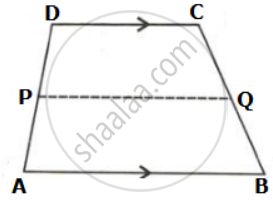
In the given figure, PS = 3RS. M is the midpoint of QR. If TR || MN || QP, then prove that: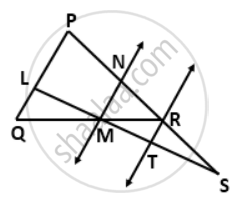
ST = `(1)/(3)"LS"`
D, E and F are the mid-points of the sides BC, CA and AB, respectively of an equilateral triangle ABC. Show that ∆DEF is also an equilateral triangle.
Show that the quadrilateral formed by joining the mid-points of the consecutive sides of a square is also a square.
