Advertisements
Advertisements
Question
ABCD is a quadrilateral in which P, Q, R and S are mid-points of the sides AB, BC, CD and DA (see the given figure). AC is a diagonal. Show that:
- SR || AC and SR = `1/2AC`
- PQ = SR
- PQRS is a parallelogram.

Advertisements
Solution
(i) In ΔADC, S and R are the mid-points of sides AD and CD respectively.
In a triangle, the line segment joining the mid-points of any two sides of the triangle is parallel to the third side and is half of it.
∴ SR || AC and SR = `1/2AC` ...(1)
(ii) In ΔABC, P and Q are mid-points of sides AB and BC respectively. Therefore, by using the mid-point theorem,
PQ || AC and PQ = `1/2AC` ...(2)
Using equations (1) and (2), we obtain
PQ || SR and PQ = SR ...(3)
⇒ PQ = SR
(iii) From equation (3), we obtained
PQ || SR and PQ = SR
Clearly, one pair of opposite sides of quadrilateral PQRS is parallel and equal.
Hence, PQRS is a parallelogram.
APPEARS IN
RELATED QUESTIONS
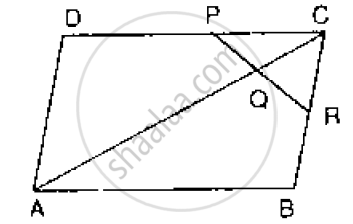
In below Fig, ABCD is a parallelogram in which P is the mid-point of DC and Q is a point on AC such that CQ = `1/4` AC. If PQ produced meets BC at R, prove that R is a mid-point of BC.
BM and CN are perpendiculars to a line passing through the vertex A of a triangle ABC. If
L is the mid-point of BC, prove that LM = LN.
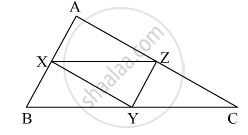
In the given figure, points X, Y, Z are the midpoints of side AB, side BC and side AC of ΔABC respectively. AB = 5 cm, AC = 9 cm and BC = 11 cm. Find the length of XY, YZ, XZ.
The following figure shows a trapezium ABCD in which AB // DC. P is the mid-point of AD and PR // AB. Prove that:
PR = `[1]/[2]` ( AB + CD)

In triangle ABC, AD is the median and DE, drawn parallel to side BA, meets AC at point E.
Show that BE is also a median.
In ΔABC, D, E, F are the midpoints of BC, CA and AB respectively. Find ∠FDB if ∠ACB = 115°.
If L and M are the mid-points of AB, and DC respectively of parallelogram ABCD. Prove that segment DL and BM trisect diagonal AC.
In ΔABC, P is the mid-point of BC. A line through P and parallel to CA meets AB at point Q, and a line through Q and parallel to BC meets median AP at point R. Prove that: AP = 2AR
ΔABC is an isosceles triangle with AB = AC. D, E and F are the mid-points of BC, AB and AC respectively. Prove that the line segment AD is perpendicular to EF and is bisected by it.
D and E are the mid-points of the sides AB and AC of ∆ABC and O is any point on side BC. O is joined to A. If P and Q are the mid-points of OB and OC respectively, then DEQP is ______.
