Advertisements
Advertisements
प्रश्न
ABCD is a quadrilateral in which P, Q, R and S are mid-points of the sides AB, BC, CD and DA (see the given figure). AC is a diagonal. Show that:
- SR || AC and SR = `1/2AC`
- PQ = SR
- PQRS is a parallelogram.

Advertisements
उत्तर
(i) In ΔADC, S and R are the mid-points of sides AD and CD respectively.
In a triangle, the line segment joining the mid-points of any two sides of the triangle is parallel to the third side and is half of it.
∴ SR || AC and SR = `1/2AC` ...(1)
(ii) In ΔABC, P and Q are mid-points of sides AB and BC respectively. Therefore, by using the mid-point theorem,
PQ || AC and PQ = `1/2AC` ...(2)
Using equations (1) and (2), we obtain
PQ || SR and PQ = SR ...(3)
⇒ PQ = SR
(iii) From equation (3), we obtained
PQ || SR and PQ = SR
Clearly, one pair of opposite sides of quadrilateral PQRS is parallel and equal.
Hence, PQRS is a parallelogram.
APPEARS IN
संबंधित प्रश्न
ABCD is a rectangle and P, Q, R and S are mid-points of the sides AB, BC, CD and DA respectively. Show that the quadrilateral PQRS is a rhombus.
In a parallelogram ABCD, E and F are the mid-points of sides AB and CD respectively (see the given figure). Show that the line segments AF and EC trisect the diagonal BD.
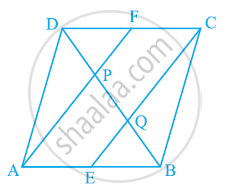
Show that the line segments joining the mid-points of the opposite sides of a quadrilateral bisect each other.
In a ΔABC, E and F are the mid-points of AC and AB respectively. The altitude AP to BC
intersects FE at Q. Prove that AQ = QP.
In ΔABC, D, E, F are the midpoints of BC, CA and AB respectively. Find ∠FDB if ∠ACB = 115°.
In parallelogram PQRS, L is mid-point of side SR and SN is drawn parallel to LQ which meets RQ produced at N and cuts side PQ at M. Prove that M is the mid-point of PQ.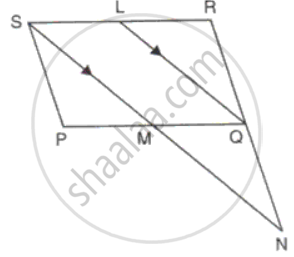
Side AC of a ABC is produced to point E so that CE = `(1)/(2)"AC"`. D is the mid-point of BC and ED produced meets AB at F. Lines through D and C are drawn parallel to AB which meets AC at point P and EF at point R respectively. Prove that: 4CR = AB.
ΔABC is an isosceles triangle with AB = AC. D, E and F are the mid-points of BC, AB and AC respectively. Prove that the line segment AD is perpendicular to EF and is bisected by it.
E is the mid-point of a median AD of ∆ABC and BE is produced to meet AC at F. Show that AF = `1/3` AC.
D, E and F are respectively the mid-points of the sides AB, BC and CA of a triangle ABC. Prove that by joining these mid-points D, E and F, the triangles ABC is divided into four congruent triangles.
