Advertisements
Advertisements
प्रश्न
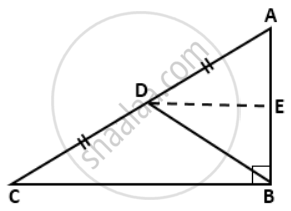
In a right-angled triangle ABC. ∠ABC = 90° and D is the midpoint of AC. Prove that BD = `(1)/(2)"AC"`.
Advertisements
उत्तर

Draw line segment DE || CB, which meets AB at point E.
Now, DE || CB and AB is the transversal,
∴ ∠AED = ∠ABC ....(corrresponding angles)
∠ABC = 90° ....(given)
⇒ ∠AED = 90°
Also, as D is the mid-point of AC and DE || CB,
DE bisects side AB,
I.e. AE = BE ....(i)
In ΔAED and ΔBED,
∠AED = ∠BED ....(Each 90°)
AE = BE ....[From (i)]
DE = DE ....(Common)
∴ ΔAED ≅ ΔBEd ....(By SAS Test)
⇒ AD = BD ....(C.P.C.T.C)
⇒ BD = AC
⇒ BD = `(1)/(2)"AC"`.
APPEARS IN
संबंधित प्रश्न
ABC is a triangle right angled at C. A line through the mid-point M of hypotenuse AB and parallel to BC intersects AC at D. Show that
- D is the mid-point of AC
- MD ⊥ AC
- CM = MA = `1/2AB`
ABCD is a kite having AB = AD and BC = CD. Prove that the figure formed by joining the
mid-points of the sides, in order, is a rectangle.
Show that the line segments joining the mid-points of the opposite sides of a quadrilateral
bisect each other.
In the given figure, M is mid-point of AB and DE, whereas N is mid-point of BC and DF.
Show that: EF = AC.
In triangle ABC, the medians BP and CQ are produced up to points M and N respectively such that BP = PM and CQ = QN. Prove that:
- M, A, and N are collinear.
- A is the mid-point of MN.
In ΔABC, D, E, F are the midpoints of BC, CA and AB respectively. Find ∠FDB if ∠ACB = 115°.
Prove that the straight lines joining the mid-points of the opposite sides of a quadrilateral bisect each other.
Show that the quadrilateral formed by joining the mid-points of the adjacent sides of a square is also a square.
ABCD is a parallelogram.E is the mid-point of CD and P is a point on AC such that PC = `(1)/(4)"AC"`. EP produced meets BC at F. Prove that: 2EF = BD.
In a parallelogram ABCD, E and F are the midpoints of the sides AB and CD respectively. The line segments AF and BF meet the line segments DE and CE at points G and H respectively Prove that: ΔHEB ≅ ΔHFC