Advertisements
Advertisements
प्रश्न
In triangle ABC, the medians BP and CQ are produced up to points M and N respectively such that BP = PM and CQ = QN. Prove that:
- M, A, and N are collinear.
- A is the mid-point of MN.
Advertisements
उत्तर
The figure is shown below
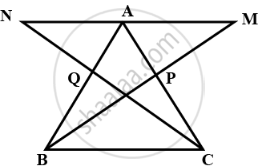
(i) In ΔAQN & ΔBQC
AQ = QB (Given)
∠AQN = ∠BQC
QN = QC
∴ ΔAQN ≅ ΔBQC ...[ by SAS ]
∴ ∠QAN = ∠QBC ...(1)
And BC = AN ……(2)
Similarly, ΔAPM ≅ ΔCPB .....[by SAS]
∠PAM = ∠PCB ...(3) [by CPTC]
And BC = AM ….( 4 )
Now In ΔABC,
∠ABC + ∠ACB + ∠BAC = 180°
∠QAN + ∠PAM + ∠BAC = 180° ...[ (1), (2) we get ]
Therefore M, A, N are collinear.
(ii) From (3) and (4) MA = NA
Hence A is the midpoint of MN.
APPEARS IN
संबंधित प्रश्न
Show that the line segments joining the mid-points of the opposite sides of a quadrilateral bisect each other.
In a ∆ABC, D, E and F are, respectively, the mid-points of BC, CA and AB. If the lengths of side AB, BC and CA are 7 cm, 8 cm and 9 cm, respectively, find the perimeter of ∆DEF.
In below Fig, ABCD is a parallelogram in which P is the mid-point of DC and Q is a point on AC such that CQ = `1/4` AC. If PQ produced meets BC at R, prove that R is a mid-point of BC.

Fill in the blank to make the following statement correct
The triangle formed by joining the mid-points of the sides of an isosceles triangle is
Fill in the blank to make the following statement correct:
The triangle formed by joining the mid-points of the sides of a right triangle is
The figure, given below, shows a trapezium ABCD. M and N are the mid-point of the non-parallel sides AD and BC respectively. Find:

- MN, if AB = 11 cm and DC = 8 cm.
- AB, if DC = 20 cm and MN = 27 cm.
- DC, if MN = 15 cm and AB = 23 cm.
In ΔABC, D, E, F are the midpoints of BC, CA and AB respectively. Find FE, if BC = 14 cm
In ΔABC, D, E, F are the midpoints of BC, CA and AB respectively. Find ∠FDB if ∠ACB = 115°.
In a parallelogram ABCD, E and F are the midpoints of the sides AB and CD respectively. The line segments AF and BF meet the line segments DE and CE at points G and H respectively Prove that: ΔGEA ≅ ΔGFD
In AABC, D and E are two points on the side AB such that AD = DE = EB. Through D and E, lines are drawn parallel to BC which meet the side AC at points F and G respectively. Through F and G, lines are drawn parallel to AB which meet the side BC at points M and N respectively. Prove that BM = MN = NC.
