मराठी

The side AC of a triangle ABC is produced to point E so that CE = AC. D is the mid-point of BC and ED produced meets AB at F. - Mathematics

Advertisements
Advertisements

प्रश्न

The side AC of a triangle ABC is produced to point E so that CE = AC. D is the mid-point of BC and ED produced meets AB at F. Lines through D and C are drawn parallel to AB which meet AC at point P and EF at point R respectively.

Prove that:

  1. 3DF = EF
  2. 4CR = AB
बेरीज
Advertisements

उत्तर

Consider the figure :
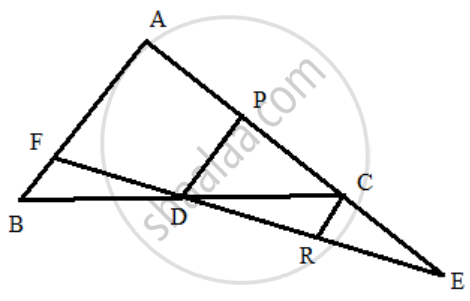
Here D is the midpoint of BC and DP is parallel to AB, therefore P is the midpoint of AC and 

PD = `[1]/[2]`AB

(i) Again from the triangle AEF, we have AF || PD || CR and AP = `[1]/[3]`AE

Therefore, DF = `[1]/[3]` EF or we can say that 3DF = EF.

Hence, it is shown.

(ii) From the triangle PED, we have PD || CR and C is the midpoint of PE, therefore, CR = `[1]/[2]`PD

Now,

PD = `1/2` AB

`1/2"PD" = 1/4`AB

CR = `1/4`AB

4CR = AB

Hence, it is shown.

shaalaa.com
  या प्रश्नात किंवा उत्तरात काही त्रुटी आहे का?
पाठ 12: Mid-point and Its Converse [ Including Intercept Theorem] - Exercise 12 (B) [पृष्ठ १५३]

APPEARS IN

सेलिना Concise Mathematics [English] Class 9 ICSE
पाठ 12 Mid-point and Its Converse [ Including Intercept Theorem]
Exercise 12 (B) | Q 3 | पृष्ठ १५३

संबंधित प्रश्‍न

In the given figure, `square`PQRS and `square`MNRL are rectangles. If point M is the midpoint of side PR then prove that,

  1. SL = LR
  2. LN = `1/2`SQ


In a right-angled triangle ABC. ∠ABC = 90° and D is the midpoint of AC. Prove that BD = `(1)/(2)"AC"`.


In parallelogram ABCD, P is the mid-point of DC. Q is a point on AC such that CQ = `(1)/(4)"AC"`. PQ produced meets BC at R. Prove that

(i) R is the mid-point of BC, and

(ii) PR = `(1)/(2)"DB"`.


In ΔABC, X is the mid-point of AB, and Y is the mid-point of AC. BY and CX are produced and meet the straight line through A parallel to BC at P and Q respectively. Prove AP = AQ.


In ΔABC, the medians BE and CD are produced to the points P and Q respectively such that BE = EP and CD = DQ. Prove that: A is the mid-point of PQ.


In ΔABC, D and E are the midpoints of the sides AB and BC respectively. F is any point on the side AC. Also, EF is parallel to AB. Prove that BFED is a parallelogram.

Remark: Figure is incorrect in Question


In the given figure, T is the midpoint of QR. Side PR of ΔPQR is extended to S such that R divides PS in the ratio 2:1. TV and WR are drawn parallel to PQ. Prove that T divides SU in the ratio 2:1 and WR = `(1)/(4)"PQ"`.


The quadrilateral formed by joining the mid-points of the sides of a quadrilateral PQRS, taken in order, is a rectangle, if ______.


The quadrilateral formed by joining the mid-points of the sides of a quadrilateral PQRS, taken in order, is a rhombus, if ______.


P, Q, R and S are respectively the mid-points of sides AB, BC, CD and DA of quadrilateral ABCD in which AC = BD and AC ⊥ BD. Prove that PQRS is a square.


Share
Notifications

Englishहिंदीमराठी


      Forgot password?
Use app×