हिंदी

In δAbc, Ab = 12 Cm and Ac = 9 Cm. If M is the Mid-point of Ab and a Straight Line Through M Parallel to Ac Cuts Bc in N, What is the Length of Mn? - Mathematics

Advertisements
Advertisements

प्रश्न

In ΔABC, AB = 12 cm and AC = 9 cm. If M is the mid-point of AB and a straight line through M parallel to AC cuts BC in N, what is the length of MN?

योग
Advertisements

उत्तर
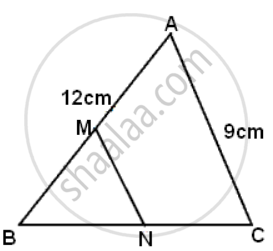

MN || AC and M is mid-point of AB

Therefore, N is mid-point of BC

Hence, MN = `(1)/(2)"AC" = (9)/(2)"cm"` = 4.5cm.

shaalaa.com
  क्या इस प्रश्न या उत्तर में कोई त्रुटि है?
अध्याय 15: Mid-point and Intercept Theorems - Exercise 15.1

APPEARS IN

फ्रैंक Mathematics [English] Class 9 ICSE
अध्याय 15 Mid-point and Intercept Theorems
Exercise 15.1 | Q 2

संबंधित प्रश्न

BM and CN are perpendiculars to a line passing through the vertex A of a triangle ABC. If
L is the mid-point of BC, prove that LM = LN.


In the Figure, `square`ABCD is a trapezium. AB || DC. Points P and Q are midpoints of seg AD and seg BC respectively. Then prove that, PQ || AB and PQ = `1/2 ("AB" + "DC")`.


In triangle ABC, the medians BP and CQ are produced up to points M and N respectively such that BP = PM and CQ = QN. Prove that:

  1. M, A, and N are collinear.
  2. A is the mid-point of MN.

In triangle ABC, D and E are points on side AB such that AD = DE = EB. Through D and E, lines are drawn parallel to BC which meet side AC at points F and G respectively. Through F and G, lines are drawn parallel to AB which meets side BC at points M and N respectively. Prove that: BM = MN = NC.


In triangle ABC; M is mid-point of AB, N is mid-point of AC and D is any point in base BC. Use the intercept Theorem to show that MN bisects AD.


ABCD is a parallelogram.E is the mid-point of CD and P is a point on AC such that PC = `(1)/(4)"AC"`. EP produced meets BC at F. Prove that: F is the mid-point of BC.


In ΔABC, D, E and F are the midpoints of AB, BC and AC.
Show that AE and DF bisect each other.


In ΔABC, the medians BE and CD are produced to the points P and Q respectively such that BE = EP and CD = DQ. Prove that: A is the mid-point of PQ.


In the given figure, T is the midpoint of QR. Side PR of ΔPQR is extended to S such that R divides PS in the ratio 2:1. TV and WR are drawn parallel to PQ. Prove that T divides SU in the ratio 2:1 and WR = `(1)/(4)"PQ"`.


E is the mid-point of a median AD of ∆ABC and BE is produced to meet AC at F. Show that AF = `1/3` AC.


Share
Notifications

Englishहिंदीमराठी


      Forgot password?
Use app×