हिंदी

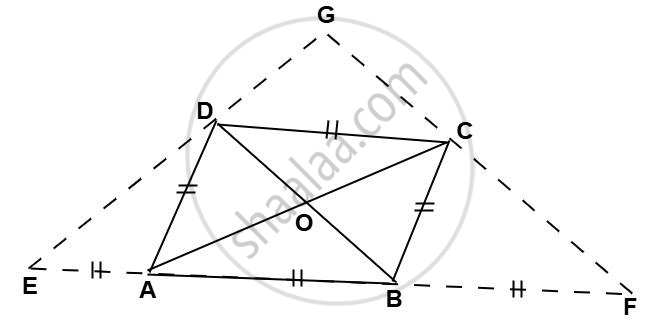
ABCD is a rhombus. EABF is a straight line such that EA = AB = BF. Prove that ED and FC when produced, meet at right angles. - Mathematics

Advertisements
Advertisements

प्रश्न

ABCD is a rhombus. EABF is a straight line such that EA = AB = BF. Prove that ED and FC when produced, meet at right angles.

प्रमेय
Advertisements

उत्तर


We know that the diagonals of a rhombus are perpendicular bisectors of each other

∴ OA = OC

OB = OD

∠AOD = ∠COD = 90°

And ∠AOB = ∠COB = 90°

In ΔBDE, A and O are midpoints of BE and BD, respectively

OA || DE

OC || DG

In ΔCFA, B and O are midpoints of AF and AC, respectively

∴ OB || CF

OD || GC

Thus, in quadrilateral DOCG, we have

OC || DG and OD || GC

⇒ DOCG is a parallelogram

∠DGC = ∠DOC

∠DGC = 90°

shaalaa.com
  क्या इस प्रश्न या उत्तर में कोई त्रुटि है?
अध्याय 13: Quadrilaterals - Exercise 13.3 [पृष्ठ ४३]

APPEARS IN

आरडी शर्मा Mathematics [English] Class 9
अध्याय 13 Quadrilaterals
Exercise 13.3 | Q 8 | पृष्ठ ४३
नूतन Mathematics [English] Class 9 ICSE
अध्याय 9 Mid-point Theorem
Exercise 9A | Q 16. | पृष्ठ १९६

वीडियो ट्यूटोरियलVIEW ALL [1]

संबंधित प्रश्न

ABCD is a rhombus and P, Q, R and S are the mid-points of the sides AB, BC, CD and DA respectively. Show that the quadrilateral PQRS is a rectangle.


ABCD is a rectangle and P, Q, R and S are mid-points of the sides AB, BC, CD and DA respectively. Show that the quadrilateral PQRS is a rhombus.


ABC is a triangle and through A, B, C lines are drawn parallel to BC, CA and AB respectively
intersecting at P, Q and R. Prove that the perimeter of ΔPQR is double the perimeter of
ΔABC


ABC is a triang D is a point on AB such that AD = `1/4` AB and E is a point on AC such that AE = `1/4` AC. Prove that DE = `1/4` BC.


Fill in the blank to make the following statement correct

The triangle formed by joining the mid-points of the sides of an isosceles triangle is         


L and M are the mid-point of sides AB and DC respectively of parallelogram ABCD. Prove that segments DL and BM trisect diagonal AC.


In trapezium ABCD, AB is parallel to DC; P and Q are the mid-points of AD and BC respectively. BP produced meets CD produced at point E.

Prove that:

  1. Point P bisects BE,
  2. PQ is parallel to AB.

In the given figure, AD and CE are medians and DF // CE.
Prove that: FB = `1/4` AB.


In triangle ABC, D and E are points on side AB such that AD = DE = EB. Through D and E, lines are drawn parallel to BC which meet side AC at points F and G respectively. Through F and G, lines are drawn parallel to AB which meets side BC at points M and N respectively. Prove that: BM = MN = NC.


In parallelogram PQRS, L is mid-point of side SR and SN is drawn parallel to LQ which meets RQ produced at N and cuts side PQ at M. Prove that M is the mid-point of PQ.


In ΔABC, BE and CF are medians. P is a point on BE produced such that BE = EP and Q is a point on CF produced such that CF = FQ. Prove that: A is the mid-point of PQ.


Show that the quadrilateral formed by joining the mid-points of the adjacent sides of a square is also a square.


In the given figure, ABCD is a trapezium. P and Q are the midpoints of non-parallel side AD and BC respectively. Find: PQ, if AB = 12 cm and DC = 10 cm.


Side AC of a ABC is produced to point E so that CE = `(1)/(2)"AC"`. D is the mid-point of BC and ED produced meets AB at F. Lines through D and C are drawn parallel to AB which meets AC at point P and EF at point R respectively. Prove that: 4CR = AB.


ΔABC is an isosceles triangle with AB = AC. D, E and F are the mid-points of BC, AB and AC respectively. Prove that the line segment AD is perpendicular to EF and is bisected by it.


ABCD is a kite in which BC = CD, AB = AD. E, F and G are the mid-points of CD, BC and AB respectively. Prove that: The line drawn through G and parallel to FE and bisects DA.


In ΔABC, X is the mid-point of AB, and Y is the mid-point of AC. BY and CX are produced and meet the straight line through A parallel to BC at P and Q respectively. Prove AP = AQ.


In AABC, D and E are two points on the side AB such that AD = DE = EB. Through D and E, lines are drawn parallel to BC which meet the side AC at points F and G respectively. Through F and G, lines are drawn parallel to AB which meet the side BC at points M and N respectively. Prove that BM = MN = NC.


In ΔABC, D and E are the midpoints of the sides AB and AC respectively. F is any point on the side BC. If DE intersects AF at P show that DP = PE.


In the given figure, T is the midpoint of QR. Side PR of ΔPQR is extended to S such that R divides PS in the ratio 2:1. TV and WR are drawn parallel to PQ. Prove that T divides SU in the ratio 2:1 and WR = `(1)/(4)"PQ"`.


Share
Notifications

Englishहिंदीमराठी


      Forgot password?
Use app×