Advertisements
Advertisements
प्रश्न
ABCD is a square E, F, G and H are points on AB, BC, CD and DA respectively, such that AE = BF = CG = DH. Prove that EFGH is a square.
Advertisements
उत्तर १

We have
AE = BF = CG = DH = x (say)
∴ BE = CF = DG = AH = y (say)
In Δ ' s AEH and BEF , we have
AE = BF
`∠`A = `∠`B
And AH = BE
So, by SAS configuration criterion, we have
ΔAEH ≅ ΔBFE
⇒ `∠`1 = `∠`2 and `∠`3 = `∠`4
But `∠`1+ `∠`3 = 90° and `∠`2 + `∠`4 = 90°
⇒ `∠`1+ `∠`3+ `∠`2 + `∠`4 = 90° + 90°
⇒ `∠`1+ `∠`4 + `∠`1+ `∠`4 = 180°
⇒ 2 (`∠`1+ `∠`4) = 180°
⇒ `∠`1+ `∠`4 = 90°
HEF = 90°
Similarly we have `∠`F = `∠`G = `∠`H = 90°
Hence, EFGH is a square
उत्तर २
We have
AE = BF = CG = DH = x (say)
∴ BE = CF = DG = AH = y (say)
In Δ ' s AEH and BEF , we have
AE = BF
`∠`A = `∠`B
And AH = BE
So, by SAS configuration criterion, we have
ΔAEH ≅ ΔBFE
⇒ `∠`1 = `∠`2 and `∠`3 = `∠`4
But `∠`1+ `∠`3 = 90° and `∠`2 + `∠`4 = 90°
⇒ `∠`1+ `∠`3+ `∠`2 + `∠`4 = 90° + 90°
⇒ `∠`1+ `∠`4 + `∠`1+ `∠`4 = 180°
⇒ 2 (`∠`1+ `∠`4) = 180°
⇒ `∠`1+ `∠`4 = 90°
HEF = 90°
Similarly we have `∠`F = `∠`G = `∠`H = 90°
Hence, EFGH is a square
APPEARS IN
संबंधित प्रश्न
ABCD is a rectangle and P, Q, R and S are mid-points of the sides AB, BC, CD and DA respectively. Show that the quadrilateral PQRS is a rhombus.
ABC is a triangle right angled at C. A line through the mid-point M of hypotenuse AB and parallel to BC intersects AC at D. Show that
- D is the mid-point of AC
- MD ⊥ AC
- CM = MA = `1/2AB`
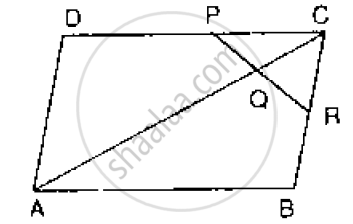
In below Fig, ABCD is a parallelogram in which P is the mid-point of DC and Q is a point on AC such that CQ = `1/4` AC. If PQ produced meets BC at R, prove that R is a mid-point of BC.
In triangle ABC, M is mid-point of AB and a straight line through M and parallel to BC cuts AC in N. Find the lengths of AN and MN if Bc = 7 cm and Ac = 5 cm.
In triangle ABC, AD is the median and DE, drawn parallel to side BA, meets AC at point E.
Show that BE is also a median.
In ΔABC, BE and CF are medians. P is a point on BE produced such that BE = EP and Q is a point on CF produced such that CF = FQ. Prove that: QAP is a straight line.
Prove that the figure obtained by joining the mid-points of the adjacent sides of a rectangle is a rhombus.
In ΔABC, D, E and F are the midpoints of AB, BC and AC.
If AE and DF intersect at G, and M and N are the midpoints of GB and GC respectively, prove that DMNF is a parallelogram.
In a parallelogram ABCD, E and F are the midpoints of the sides AB and CD respectively. The line segments AF and BF meet the line segments DE and CE at points G and H respectively Prove that: EGFH is a parallelogram.
In AABC, D and E are two points on the side AB such that AD = DE = EB. Through D and E, lines are drawn parallel to BC which meet the side AC at points F and G respectively. Through F and G, lines are drawn parallel to AB which meet the side BC at points M and N respectively. Prove that BM = MN = NC.