हिंदी

In Parallelogram Abcd, E is the Mid-point of Ab and Ap is Parallel to Ec Which Meets Dc at Point O and Bc Produced at P. Prove That: (I) Bp = 2ad (Ii) O is the Mid-point of Ap.

Advertisements
Advertisements

प्रश्न

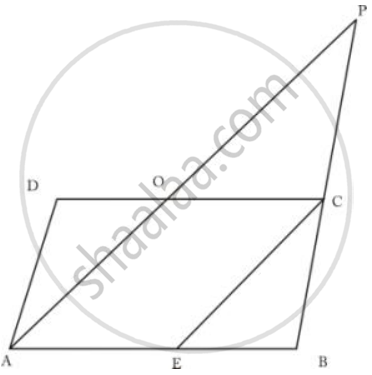
In parallelogram ABCD, E is the mid-point of AB and AP is parallel to EC which meets DC at point O and BC produced at P.
Prove that:
(i) BP = 2AD
(ii) O is the mid-point of AP.
योग
Advertisements

उत्तर

Given ABCD is parallelogram, so AD = BC, AB = CD.

Consider triangle APB, given EC, is parallel to AP and E is the midpoint of side AB.
So by midpoint theorem,
C has to be the midpoint of BP.

So BP = 2BC, but BC = AD as ABCD is a parallelogram.
Hence BP = 2AD

Consider triangle APB, AB || OC as ABCD is a parallelogram.
So by midpoint theorem,
O has to be the midpoint of AP.
Hence Proved.

shaalaa.com
  क्या इस प्रश्न या उत्तर में कोई त्रुटि है?
अध्याय 11: Mid-point Theorem and Its Converse [Including Intercept Theorem] - Exercise 12 (B) [पृष्ठ १५४]

APPEARS IN

सेलिना Concise Mathematics [English] Class 9 ICSE
अध्याय 11 Mid-point Theorem and Its Converse [Including Intercept Theorem]
Exercise 12 (B) | Q 12 | पृष्ठ १५४

संबंधित प्रश्न

ABC is a triangle and through A, B, C lines are drawn parallel to BC, CA and AB respectively
intersecting at P, Q and R. Prove that the perimeter of ΔPQR is double the perimeter of
ΔABC


In the given figure, points X, Y, Z are the midpoints of side AB, side BC and side AC of ΔABC respectively. AB = 5 cm, AC = 9 cm and BC = 11 cm. Find the length of XY, YZ, XZ.


ABCD is a quadrilateral in which AD = BC. E, F, G and H are the mid-points of AB, BD, CD and Ac respectively. Prove that EFGH is a rhombus.


A parallelogram ABCD has P the mid-point of Dc and Q a point of Ac such that

CQ = `[1]/[4]`AC. PQ produced meets BC at R.

Prove that
(i)R is the midpoint of BC
(ii) PR = `[1]/[2]` DB


In triangle ABC; M is mid-point of AB, N is mid-point of AC and D is any point in base BC. Use the intercept Theorem to show that MN bisects AD.


If the quadrilateral formed by joining the mid-points of the adjacent sides of quadrilateral ABCD is a rectangle,
show that the diagonals AC and BD intersect at the right angle.


In a right-angled triangle ABC. ∠ABC = 90° and D is the midpoint of AC. Prove that BD = `(1)/(2)"AC"`.


In ΔABC, D and E are the midpoints of the sides AB and BC respectively. F is any point on the side AC. Also, EF is parallel to AB. Prove that BFED is a parallelogram.

Remark: Figure is incorrect in Question


D, E and F are the mid-points of the sides BC, CA and AB, respectively of an equilateral triangle ABC. Show that ∆DEF is also an equilateral triangle.


Prove that the line joining the mid-points of the diagonals of a trapezium is parallel to the parallel sides of the trapezium.


Share
Notifications

Englishहिंदीमराठी


      Forgot password?
Use app×