हिंदी

In Trapezium Abcd, Sides Ab and Dc Are Parallel to Each Other. E is Mid-point of Ad and F is Mid-point of Bc. Prove That: Ab + Dc = 2ef. - Mathematics

Advertisements
Advertisements

प्रश्न

In trapezium ABCD, sides AB and DC are parallel to each other. E is mid-point of AD and F is mid-point of BC.
Prove that: AB + DC = 2EF.

योग
Advertisements

उत्तर

Consider trapezium ABCD.
Given E and F are midpoints on sides AD and BC, respectively.
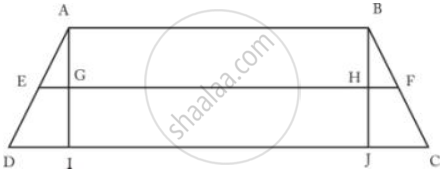
We know that AB = GH = IJ
From midpoint theorem,

EG = `1/2"DI",  "HF" = 1/2`JC

Consider LHS,
AB + CD = AB + CJ + JI + ID = AB + 2HF + AB + 2EG

So, AB + CD = 2( AB + HF + EG ) = 2( EG + GH + HF ) = 2EF

AB + CD = 2EF

Hence Proved.

shaalaa.com
  क्या इस प्रश्न या उत्तर में कोई त्रुटि है?
अध्याय 12: Mid-point and Its Converse [ Including Intercept Theorem] - Exercise 12 (B) [पृष्ठ १५४]

APPEARS IN

सेलिना Concise Mathematics [English] Class 9 ICSE
अध्याय 12 Mid-point and Its Converse [ Including Intercept Theorem]
Exercise 12 (B) | Q 13 | पृष्ठ १५४

संबंधित प्रश्न

ABCD is a trapezium in which AB || DC, BD is a diagonal and E is the mid-point of AD. A line is drawn through E parallel to AB intersecting BC at F (see the given figure). Show that F is the mid-point of BC.


Fill in the blank to make the following statement correct

The triangle formed by joining the mid-points of the sides of an isosceles triangle is         


The following figure shows a trapezium ABCD in which AB // DC. P is the mid-point of AD and PR // AB. Prove that:

PR = `[1]/[2]` ( AB + CD)


In ΔABC, BE and CF are medians. P is a point on BE produced such that BE = EP and Q is a point on CF produced such that CF = FQ. Prove that: QAP is a straight line.


In ΔABC, BE and CF are medians. P is a point on BE produced such that BE = EP and Q is a point on CF produced such that CF = FQ. Prove that: A is the mid-point of PQ.


In parallelogram ABCD, P is the mid-point of DC. Q is a point on AC such that CQ = `(1)/(4)"AC"`. PQ produced meets BC at R. Prove that

(i) R is the mid-point of BC, and

(ii) PR = `(1)/(2)"DB"`.


The diagonals AC and BD of a quadrilateral ABCD intersect at right angles. Prove that the quadrilateral formed by joining the midpoints of quadrilateral ABCD is a rectangle.


In ∆ABC, AB = 5 cm, BC = 8 cm and CA = 7 cm. If D and E are respectively the mid-points of AB and BC, determine the length of DE.


P, Q, R and S are respectively the mid-points of sides AB, BC, CD and DA of quadrilateral ABCD in which AC = BD and AC ⊥ BD. Prove that PQRS is a square.


Prove that the line joining the mid-points of the diagonals of a trapezium is parallel to the parallel sides of the trapezium.


Share
Notifications

Englishहिंदीमराठी


      Forgot password?
Use app×