Advertisements
Advertisements
Question
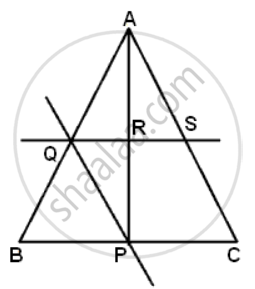
In ΔABC, P is the mid-point of BC. A line through P and parallel to CA meets AB at point Q, and a line through Q and parallel to BC meets median AP at point R. Prove that: BC = 4QR
Advertisements
Solution

In ΔABC,
Q and S are the mid-points of AB and AC respectively. Also QS is parallel to BC
Therefore, QS = `(1)/(2)"BC"` ......(i)
Now, AP is the median, hence it bisects BC and QS
Therefore
`(1)/(2)"QS"` = QR
⇒ QS = 2QR
Substituting in (i)
⇒ 2QR = `(1)/(2)"BC"`
⇒ BC = 4QR.
APPEARS IN
RELATED QUESTIONS
ABCD is a kite having AB = AD and BC = CD. Prove that the figure formed by joining the
mid-points of the sides, in order, is a rectangle.
Let Abc Be an Isosceles Triangle in Which Ab = Ac. If D, E, F Be the Mid-points of the Sides Bc, Ca and a B Respectively, Show that the Segment Ad and Ef Bisect Each Other at Right Angles.
In the given figure, M is mid-point of AB and DE, whereas N is mid-point of BC and DF.
Show that: EF = AC.
In ∆ABC, E is the mid-point of the median AD, and BE produced meets side AC at point Q.
Show that BE: EQ = 3: 1.
In a triangle ABC, AD is a median and E is mid-point of median AD. A line through B and E meets AC at point F.
Prove that: AC = 3AF.
In ΔABC, D, E, F are the midpoints of BC, CA and AB respectively. Find FE, if BC = 14 cm
Prove that the straight lines joining the mid-points of the opposite sides of a quadrilateral bisect each other.
Show that the quadrilateral formed by joining the mid-points of the adjacent sides of a square is also a square.
In ∆ABC, AB = 5 cm, BC = 8 cm and CA = 7 cm. If D and E are respectively the mid-points of AB and BC, determine the length of DE.
Show that the quadrilateral formed by joining the mid-points of the consecutive sides of a square is also a square.