Advertisements
Advertisements
Question
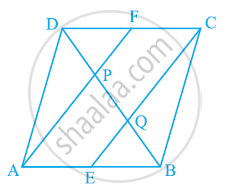
In a parallelogram ABCD, E and F are the mid-points of sides AB and CD respectively (see the given figure). Show that the line segments AF and EC trisect the diagonal BD.
Advertisements
Solution
ABCD is a parallelogram.
∴ AB || CD
And hence, AE || FC
Again, AB = CD ...(Opposite sides of parallelogram ABCD)
`1/2 AB` = `1/2 CD`
AE = FC ...(E and F are mid-points of side AB and CD)
In quadrilateral AECF, one pair of opposite sides (AE and CF) is parallel and equal to each other. Therefore, AECF is a parallelogram.
⇒ AF || EC ...(Opposite sides of a parallelogram)
In ΔDQC, F is the mid-point of side DC and FP || CQ (as AF || EC). Therefore, by using the converse of mid-point theorem, it can be said that P is the mid-point of DQ.
⇒ DP = PQ ...(1)
Similarly, in ΔAPB, E is the mid-point of side AB and EQ || AP (as AF || EC). Therefore, by using the converse of mid-point theorem, it can be said that Q is the mid-point of PB.
⇒ PQ = QB ...(2)
From equations (1) and (2),
DP = PQ = BQ
Hence, the line segments AF and EC trisect the diagonal BD.
APPEARS IN
RELATED QUESTIONS
In a ΔABC, E and F are the mid-points of AC and AB respectively. The altitude AP to BC
intersects FE at Q. Prove that AQ = QP.
Let Abc Be an Isosceles Triangle in Which Ab = Ac. If D, E, F Be the Mid-points of the Sides Bc, Ca and a B Respectively, Show that the Segment Ad and Ef Bisect Each Other at Right Angles.
Show that the line segments joining the mid-points of the opposite sides of a quadrilateral
bisect each other.
Use the following figure to find:
(i) BC, if AB = 7.2 cm.
(ii) GE, if FE = 4 cm.
(iii) AE, if BD = 4.1 cm
(iv) DF, if CG = 11 cm.

In triangle ABC, D and E are mid-points of the sides AB and AC, respectively. Through E, a straight line is drawn parallel to AB to meet BC at F. Prove that BDEF is a parallelogram. If AB = 8 cm and BC = 9 cm, find the perimeter of the parallelogram BDEF.
The diagonals of a quadrilateral intersect each other at right angle. Prove that the figure obtained by joining the mid-points of the adjacent sides of the quadrilateral is a rectangle.
In a parallelogram ABCD, E and F are the midpoints of the sides AB and CD respectively. The line segments AF and BF meet the line segments DE and CE at points G and H respectively Prove that: ΔHEB ≅ ΔHFC
In the given figure, PS = 3RS. M is the midpoint of QR. If TR || MN || QP, then prove that: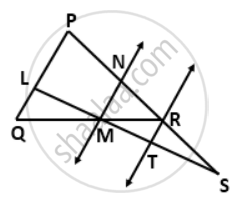
ST = `(1)/(3)"LS"`
P, Q, R and S are respectively the mid-points of the sides AB, BC, CD and DA of a quadrilateral ABCD in which AC = BD. Prove that PQRS is a rhombus.
E and F are respectively the mid-points of the non-parallel sides AD and BC of a trapezium ABCD. Prove that EF || AB and EF = `1/2` (AB + CD).
[Hint: Join BE and produce it to meet CD produced at G.]
