English

In a Parallelogram Abcd, E and F Are the Midpoints of the Sides Ab and Cd Respectively. the Line Segments Af and Bf Meet the Line Segments De and Ce at Points G and H Respectively Prove That: Egfh I - Mathematics

Advertisements
Advertisements

Question

In a parallelogram ABCD, E and F are the midpoints of the sides AB and CD respectively. The line segments AF and BF meet the line segments DE and CE at points G and H respectively Prove that: EGFH is a parallelogram.

Sum
Advertisements

Solution
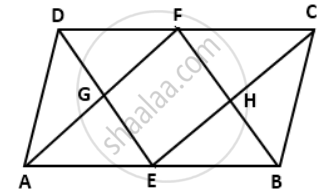

In quadrilateral AECF,
AE = CF   ....[from (i)]
AE || CF   ....[as AB || DC]
⇒ AECF is a parallelogram.
⇒ EC || AF or EH || GF      ....(i)
In quadrilateral BFDE,
BE = DF  ....[from (i)]
BE || DF  ....[as AB || DC]
⇒ BEDF is a parallelogram  
⇒ BF || ED or HF || EG     ....(ii)
From (i) and (ii), we get that
EGFH is parallelogram.

shaalaa.com
  Is there an error in this question or solution?
Chapter 15: Mid-point and Intercept Theorems - Exercise 15.2

APPEARS IN

Frank Mathematics [English] Class 9 ICSE
Chapter 15 Mid-point and Intercept Theorems
Exercise 15.2 | Q 1.3

RELATED QUESTIONS

In a triangle ∠ABC, ∠A = 50°, ∠B = 60° and ∠C = 70°. Find the measures of the angles of

the triangle formed by joining the mid-points of the sides of this triangle. 


In Fig. below, M, N and P are the mid-points of AB, AC and BC respectively. If MN = 3 cm, NP = 3.5 cm and MP = 2.5 cm, calculate BC, AB and AC.


The following figure shows a trapezium ABCD in which AB // DC. P is the mid-point of AD and PR // AB. Prove that:

PR = `[1]/[2]` ( AB + CD)


Use the following figure to find:
(i) BC, if AB = 7.2 cm.
(ii) GE, if FE = 4 cm.
(iii) AE, if BD = 4.1 cm
(iv) DF, if CG = 11 cm.


In triangle ABC; M is mid-point of AB, N is mid-point of AC and D is any point in base BC. Use the intercept Theorem to show that MN bisects AD.


D, E and F are the mid-points of the sides AB, BC and CA of an isosceles ΔABC in which AB = BC. Prove that ΔDEF is also isosceles.


ABCD is a kite in which BC = CD, AB = AD. E, F and G are the mid-points of CD, BC and AB respectively. Prove that: The line drawn through G and parallel to FE and bisects DA.


In a parallelogram ABCD, E and F are the midpoints of the sides AB and CD respectively. The line segments AF and BF meet the line segments DE and CE at points G and H respectively Prove that: ΔHEB ≅ ΔHFC


In the given figure, T is the midpoint of QR. Side PR of ΔPQR is extended to S such that R divides PS in the ratio 2:1. TV and WR are drawn parallel to PQ. Prove that T divides SU in the ratio 2:1 and WR = `(1)/(4)"PQ"`.


P, Q, R and S are respectively the mid-points of the sides AB, BC, CD and DA of a quadrilateral ABCD in which AC = BD. Prove that PQRS is a rhombus.


Share
Notifications

Englishहिंदीमराठी


      Forgot password?
Use app×