Advertisements
Advertisements
प्रश्न
D, E and F are respectively the mid-points of the sides AB, BC and CA of a triangle ABC. Prove that by joining these mid-points D, E and F, the triangles ABC is divided into four congruent triangles.
Advertisements
उत्तर
Given: In a ΔABC, D, E and F are respectively the mid-points of the sides AB, BC and CA.
To prove: ΔABC is divided into four congruent triangles.
Proof: Since, ABC is a triangle and D, E and F are the mid-points of sides AB, BC and CA, respectively.

Then, AD = BD = `1/2`AB, BE = EC = `1/2`BC
And AF = CF = `1/2`AC
Now, using the mid-point theorem,
EF || AB and EF = `1/2`AB = AD = BD
ED || AC and ED = `1/2`AC = AF = CF
And DF || BC and DF = `1/2`BC = BE = CE
In ΔADF and ΔEFD,
AD = EF
AF = DE
And DF = FD ...[Common]
∴ ΔADF ≅ ΔEFD ...[By SSS congruence rule]
Similarly, ΔDEF ≅ ΔEDB
And ΔDEF ≅ ΔCFE
So, ΔABC is divided into four congruent triangles.
Hence proved.
APPEARS IN
संबंधित प्रश्न
ABCD is a rhombus. EABF is a straight line such that EA = AB = BF. Prove that ED and FC when produced, meet at right angles.
ABCD is a parallelogram, E and F are the mid-points of AB and CD respectively. GH is any line intersecting AD, EF and BC at G, P and H respectively. Prove that GP = PH.
D, E, and F are the mid-points of the sides AB, BC and CA of an isosceles ΔABC in which AB = BC.
Prove that ΔDEF is also isosceles.
The side AC of a triangle ABC is produced to point E so that CE = AC. D is the mid-point of BC and ED produced meets AB at F. Lines through D and C are drawn parallel to AB which meet AC at point P and EF at point R respectively.
Prove that:
- 3DF = EF
- 4CR = AB
In parallelogram PQRS, L is mid-point of side SR and SN is drawn parallel to LQ which meets RQ produced at N and cuts side PQ at M. Prove that M is the mid-point of PQ.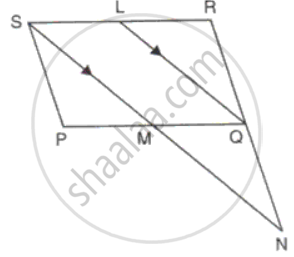
If L and M are the mid-points of AB, and DC respectively of parallelogram ABCD. Prove that segment DL and BM trisect diagonal AC.
In ΔABC, P is the mid-point of BC. A line through P and parallel to CA meets AB at point Q, and a line through Q and parallel to BC meets median AP at point R. Prove that: BC = 4QR
The diagonals AC and BD of a quadrilateral ABCD intersect at right angles. Prove that the quadrilateral formed by joining the midpoints of quadrilateral ABCD is a rectangle.
P and Q are the mid-points of the opposite sides AB and CD of a parallelogram ABCD. AQ intersects DP at S and BQ intersects CP at R. Show that PRQS is a parallelogram.
E is the mid-point of a median AD of ∆ABC and BE is produced to meet AC at F. Show that AF = `1/3` AC.
