Advertisements
Advertisements
प्रश्न
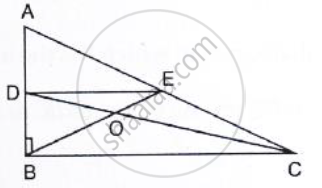
In Fig. below, triangle ABC is right-angled at B. Given that AB = 9 cm, AC = 15 cm and D,
E are the mid-points of the sides AB and AC respectively, calculate
(i) The length of BC (ii) The area of ΔADE.
Advertisements
उत्तर

In right ΔABC, ∠B = 90°
By using Pythagoras theorem
`AC^2 = AB^2+ BC^2`
⇒ `15^2 = 9^2 +BC^2`
⇒ BC =`sqrt(15^2 - 9^2)`
⇒ BC =`sqrt(225-81)`
⇒ BC =`sqrt144`
= 12cm
In ΔABC
D and E are midpoints of AB and AC
∴ DE || BC, DE = `1/2` BC [By midpoint theorem]
AD = OB = `(AB)/ 2= 9/2` = 4 . 5cm [ ∵ D is the midpoint of AB]
DE = `(BC)/2 = 12/2` = 6cm
Area of ΔADE = `1/2 xxAD xx DE `
= `1/2× 4 .5 × 6 = 13.5cm^2`
APPEARS IN
संबंधित प्रश्न
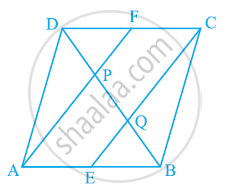
In a parallelogram ABCD, E and F are the mid-points of sides AB and CD respectively (see the given figure). Show that the line segments AF and EC trisect the diagonal BD.
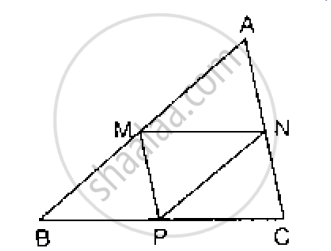
In Fig. below, M, N and P are the mid-points of AB, AC and BC respectively. If MN = 3 cm, NP = 3.5 cm and MP = 2.5 cm, calculate BC, AB and AC.
ABC is a triangle and through A, B, C lines are drawn parallel to BC, CA and AB respectively
intersecting at P, Q and R. Prove that the perimeter of ΔPQR is double the perimeter of
ΔABC
The following figure shows a trapezium ABCD in which AB // DC. P is the mid-point of AD and PR // AB. Prove that:
PR = `[1]/[2]` ( AB + CD)

In trapezium ABCD, sides AB and DC are parallel to each other. E is mid-point of AD and F is mid-point of BC.
Prove that: AB + DC = 2EF.
In ΔABC, BE and CF are medians. P is a point on BE produced such that BE = EP and Q is a point on CF produced such that CF = FQ. Prove that: QAP is a straight line.
ABCD is a kite in which BC = CD, AB = AD. E, F and G are the mid-points of CD, BC and AB respectively. Prove that: The line drawn through G and parallel to FE and bisects DA.
In the given figure, PS = 3RS. M is the midpoint of QR. If TR || MN || QP, then prove that: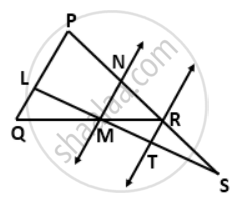
RT = `(1)/(3)"PQ"`
E is the mid-point of the side AD of the trapezium ABCD with AB || DC. A line through E drawn parallel to AB intersect BC at F. Show that F is the mid-point of BC. [Hint: Join AC]
Prove that the line joining the mid-points of the diagonals of a trapezium is parallel to the parallel sides of the trapezium.
