हिंदी

In Parallelogram Abcd, E and F Are Mid-points of the Sides Ab and Cd Respectively. the Line Segments Af and Bf Meet the Line Segments Ed and Ec at Points G and H Respectively - Mathematics

Advertisements
Advertisements

प्रश्न

In parallelogram ABCD, E and F are mid-points of the sides AB and CD respectively. The line segments AF and BF meet the line segments ED and EC at points G and H respectively.
Prove that:
(i) Triangles HEB and FHC are congruent;
(ii) GEHF is a parallelogram.

योग
Advertisements

उत्तर

The figure is shown below
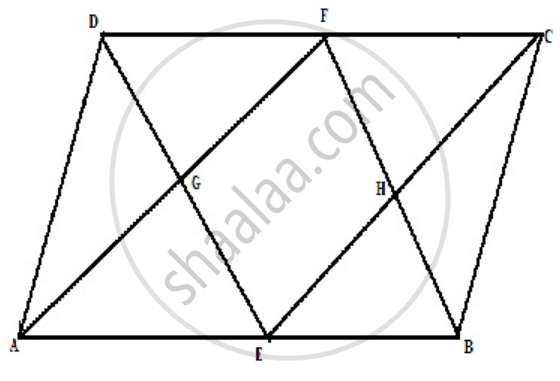
(i) From ΔHEB and ΔFHC
BE = FC
∠EHB = ∠FHC                        ...[ Opposite angle ]
∠HBE = ∠HFC
∴  ΔHEB ≅ ΔFHC
∴  EH = CH , BH = FH

(ii) Similarly AG = GF and EG = DG      …..(1)
For triangle ECD,
F and H are the mid-point of CD and EC.
Therefore HF || DE and 
HF = `[1]/[2]` DE                                          ....(2)

From (1) and (2) we get,
HF = EG and HF || EG
Similarly, we can show that EH = GF and EH || GF
Therefore GEHF is a parallelogram.

shaalaa.com
  क्या इस प्रश्न या उत्तर में कोई त्रुटि है?
अध्याय 12: Mid-point and Its Converse [ Including Intercept Theorem] - Exercise 12 (B) [पृष्ठ १५४]

APPEARS IN

सेलिना Concise Mathematics [English] Class 9 ICSE
अध्याय 12 Mid-point and Its Converse [ Including Intercept Theorem]
Exercise 12 (B) | Q 6 | पृष्ठ १५४

संबंधित प्रश्न

In a parallelogram ABCD, E and F are the mid-points of sides AB and CD respectively (see the given figure). Show that the line segments AF and EC trisect the diagonal BD.


In a ∆ABC, D, E and F are, respectively, the mid-points of BC, CA and AB. If the lengths of side AB, BC and CA are 7 cm, 8 cm and 9 cm, respectively, find the perimeter of ∆DEF.


BM and CN are perpendiculars to a line passing through the vertex A of a triangle ABC. If
L is the mid-point of BC, prove that LM = LN.


In triangle ABC, angle B is obtuse. D and E are mid-points of sides AB and BC respectively and F is a point on side AC such that EF is parallel to AB. Show that BEFD is a parallelogram.


In parallelogram ABCD, P is the mid-point of DC. Q is a point on AC such that CQ = `(1)/(4)"AC"`. PQ produced meets BC at R. Prove that

(i) R is the mid-point of BC, and

(ii) PR = `(1)/(2)"DB"`.


Show that the quadrilateral formed by joining the mid-points of the adjacent sides of a square is also a square.


ABCD is a kite in which BC = CD, AB = AD. E, F and G are the mid-points of CD, BC and AB respectively. Prove that: ∠EFG = 90°


In ΔABC, X is the mid-point of AB, and Y is the mid-point of AC. BY and CX are produced and meet the straight line through A parallel to BC at P and Q respectively. Prove AP = AQ.


The quadrilateral formed by joining the mid-points of the sides of a quadrilateral PQRS, taken in order, is a rectangle, if ______.


P, Q, R and S are respectively the mid-points of the sides AB, BC, CD and DA of a quadrilateral ABCD such that AC ⊥ BD. Prove that PQRS is a rectangle.


Share
Notifications

Englishहिंदीमराठी


      Forgot password?
Use app×