Advertisements
Advertisements
प्रश्न
Prove that the quadrilateral formed by the bisectors of the angles of a parallelogram is a rectangle.
Advertisements
उत्तर

Given: Let ABCD be a parallelogram and AP, BR, CR, be are the bisectors of ∠A, ∠B, ∠C and ∠D, respectively.
To prove: Quadrilateral PQRS is a rectangle.
Proof: Since, ABCD is a parallelogram, then DC || AB and DA is a transversal.
∠A + ∠D = 180° ...[Sum of cointerior angles of a parallelogram is 180°]
⇒ `1/2` ∠A + `1/2` ∠D = 90° ...[Dividing both sides by 2]
∠PAD + ∠PDA = 90°
∠APD = 90° ...[Since, sum of all angles of a triangle is 180°]
∴ ∠SPQ = 90° ...[Vertically opposite angles]
∠PQR = 90°
∠QRS = 90°
And ∠PSR = 90°
Thus, PQRS is a quadrilateral whose each angle is 90°.
Hence, PQRS is a rectangle.
APPEARS IN
संबंधित प्रश्न
In a parallelogram ABCD, determine the sum of angles ∠C and ∠D .
The sides AB and CD of a parallelogram ABCD are bisected at E and F. Prove that EBFD is a parallelogram.
In a ΔABC median AD is produced to X such that AD = DX. Prove that ABXC is a
parallelogram.
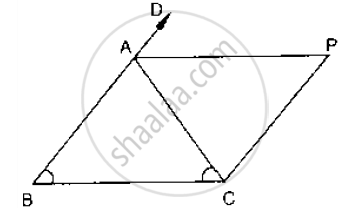
In Fig. below, AB = AC and CP || BA and AP is the bisector of exterior ∠CAD of ΔABC.
Prove that (i) ∠PAC = ∠BCA (ii) ABCP is a parallelogram
The figure formed by joining the mid-points of the adjacent sides of a rhombus is a
The figure formed by joining the mid-points of the adjacent sides of a parallelogram is a
ABCD is a parallelogram in which diagonal AC bisects ∠BAD. If ∠BAC = 35°, then ∠ABC =
In the given figure, ∠A = 64°, ∠ABC = 58°. If BO and CO are the bisectors of ∠ABC and ∠ACB respectively of ΔABC, find x° and y°
In the given Figure, if AB = 2, BC = 6, AE = 6, BF = 8, CE = 7, and CF = 7, compute the ratio of the area of quadrilateral ABDE to the area of ΔCDF. (Use congruent property of triangles)
ABCD is a square, diagonals AC and BD meet at O. The number of pairs of congruent triangles with vertex O are
