Advertisements
Advertisements
Question
Explain how spectrum is formed.
Advertisements
Solution
When white light passes through a glass prism, it spreads out into a band of different colours called the spectrum of light.

- When white light is dispersed into seven colours by a glass prism, different colours bend through different angles with respect to the incident ray.
- The sequence of colours given by the prism is Violet, Indigo, Blue, Green, Yellow, Orange and Red.
- Of the seven colours, red light bends the least, while violet light bends the most. So, the rays of each colour emerge along different paths and appear distinct. Hence, we get a spectrum of seven different colours.
APPEARS IN
RELATED QUESTIONS
Write a short note on dispersion of light.
Four students P, Q, R and S traced the path of a ray of light passing through a glass slab for an angle of incidence 40° and measured the angle of refraction. The values as measured them were 18°; 22°; 25° and 30° respectively. The student who has performed the experiment methodically is
(A) P
(B) Q
(C) R
(D) S
Why do we get a spectrum of seven colors when white light is dispersed by a prism?
Explain the term absolute refractive index of a medium and write an expression to relate it with the speed of light in vacuum.
State the dependence of angle of deviation On the refractive index of the material of the prism.
The speed of light in glass is 2 × 10⁵ km/s. What is the refractive index of glass?
Which colour of light travels fastest in any medium except air?
Which of the above wavelengths has a higher frequency?
How is the reflection of light ray from a plane mirror different from the refraction of light ray as it enters a block of glass?
How can you bend light away from the normal?
A monochromatic ray of light passes from air to glass. The wavelength of light in air is λ, the speed of light in air is c and in glass is V. If the absolute refractive index of glass is 1.5, write down
- the relationship between c and V,
- the wavelength of light in glass.
When a ray of light from air enters a denser medium, it ______.
How does the angle of minimum deviation produces by a prism change with increase in :
the wavelength of incident light
Fill in the blanks to complete the following sentence
The refractive index of glass with respect to air is 3/2. The refractive index of air with respect to glass will be ……………….
A coin is places at the bottom of a beaker containing water (refractive index = 4/3) to a depth of 12 cm. By what height the coin appears to be raised when seen from vertically above?
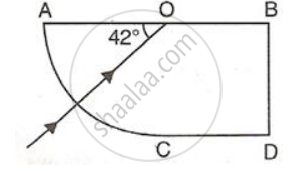
A ray of light enters a glass slab ABDC as shown in figure and strikes at the centre O of the circular part AC of the slab. The critical angle of glass is 42°. Complete the path of the ray till it emerges out from the slab. Mark the angles in the diagram wherever necessary.
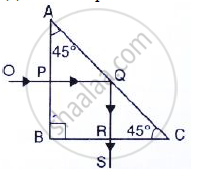
A ray of light OP passes through a right angles prism as shown in the adjacent diagram.
(a) State the angles of incidence at the faces AC and BC.
(b) Name the phenomenon which the ray suffers at the face AC.
After tracing the path of rays of light through a glass slab for three different angles of incidence, a student measured the corresponding values angle of refraction r and angle of emergence e and recorded them in the table given below:
|
S. No. |
∠i |
∠i |
∠e |
|
I |
30° |
20° |
31° |
|
II |
40° |
25° |
40° |
|
III |
50° |
31° |
49° |
The correct observations are:
(A) I and II
(B) II and III
(C) I and III
(D) I, II and III
Four students showed the following traces of the path of a ray of light passing through a rectangular glass slab.

The trace most likely to be correct is that of student
(A) I
(B) II
(C) III
(D) IV
Rahim recorded the following sets of observations while tracing the path of a ray of light passing through a rectangular glass slab for different angles of incidence.
|
S. No. |
Angle of incidence |
Angle of refraction |
Angle of emergence |
|
I |
45° |
41° |
45° |
|
II |
40° |
38° |
38° |
|
III |
45° |
41° |
40° |
|
IV |
41° |
45° |
41° |
The correct observation is recorded at serial number:
(1) I
(2) II
(3) III
(4) IV
Four students A, B, C and D traced the paths of incident ray and the emergent ray by fixing pins P and Q for incident ray and pins R and S for emergent ray for a ray of light passing through a glass slab.

The correct emergent ray was traced by the student:
(1) A
(2) B
(3) C
(4) D
(i) What is the relation between the refractive index of water with respect to air `("_aμ_\text(w))` and the refractive index of air with respect to water `("_\text(w)μ_ a)` .
(ii) If the refractive index of water with respect to air `("_aμ_\text(w))` is`5/3`. Calculate the refractive index of air with respect to water `("_\text(w)μ_ a)` .
What is the refractive index of water
You are provided with a printed piece of paper. Using this paper how will you differentiate between a convex lens and a concave lens?
In the diagram below, PQ is a ray of light incident on a rectangular glass block.

How are the angles ‘i’ and ‘e’ related to each other?
Draw ray of light bending towards the normal while passing from air to glass. Label your diagrams.
Light passes through a rectangular glass slab and through a triangular glass prism. In what way does the direction of the two emergent beams differ and why?
A ray of monochromatic light is incident from the air on a glass slab:
(i) Draw a labelled ray diagram showing the change in the path of the ray till it emerges from the glass slab.
(ii) Name the two rays that are parallel to each other.
(iii) Mark the lateral displacement in your diagram.
How will you verify the laws of refraction or how the refractive index of glass is determined in the laboratory?
The diagram shows the path of a ray of light through a rectangular glass block placed in a liquid of uniform density.

What is the angular, deviation of the emergent ray from the glass block with respect to the incident ray?
The diagram shows the path of a ray of light through a rectangular glass block placed in a liquid of uniform density.
Show with the help of a ray diagram the path of the ray when incident ray normally falls on the first surface of the glass block and passes through the block and the liquid.
The diagram shows the path of a ray of light through a rectangular glass block placed in a liquid of uniform density.
What should be the rate of the speed of light through the liquid to the speed through the glass so that there is no refraction of light at the boundaries of the glass block when the system is illuminated by the light of one colour?
A ray of light is incident at an angle of 45° on one face of a rectangular glass slab of thickness 10 cm and refractive index 3/2. Calculate the lateral shift produced ______.
Which colour of white light travels fastest in any medium except air?
