Advertisements
Advertisements
Question
Predict the possible product of the following reaction.
nitration of toluene
Advertisements
Solution
The Methyl group is the ortho and para directing group. So, nitration of toluene gives p-nitrotoluene and o-nitrotoluene.
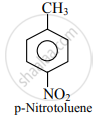
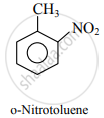
APPEARS IN
RELATED QUESTIONS
Name the following:
The hydrocarbon said to possess carcinogenic property.
Predict the possible product of the following reaction.
Chlorination of nitrobenzene
Predict the possible product of the following reaction.
sulphonation of chlorobenzene
Identify giving reason whether the following compound is aromatic or not.
Major product of the below mentioned reaction is, \[\ce{(CH3 )2 C = CH2 ->[ICI]}\]
Identify the compound (A) in the following reaction
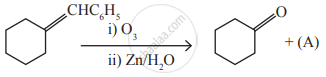
Which one of the following is non aromatic?
Which of the following compounds will not undergo Friedal – crafts reaction easily ? (NEET)
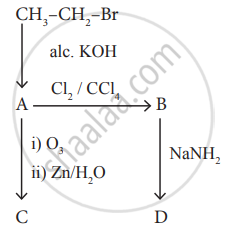
Identify the compound A, B, C and D in the following series of reactions.
Describe the mechanism of Nitration of benzene.
Suggest the route for the preparation of the following from benzene.
4 – chlorotoluene
What happens when Isobutylene is treated with acidified potassium permanganate?
How will you convert ethyl chloride into n – butane?
How will you prepare propane from a sodium salt of fatty acid?
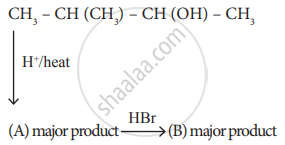
Identify A and B.
A compound with molecular formula C4H4O has all the four carbon atom and the oxygen atom in the ring. It also has two carbon-carbon double bonds. The compound is ____________.
Which among the following compounds has highest boiling point?
Phenol on distillation with zinc dust gives ____________.
Which of the following is INCORRECT for aromatic hydrocarbons?
Dow's process is used for the synthesis of an aromatic compound (X). Identify X.
Which of the following compounds is NOT obtained in thermal decomposition of propane in absence of air?
The treatment of benzene with iso - butene in the presence of sulphuric acid gives:
Conversion of hexane into benzene involves the reaction of ______.
Arenes on treatments with chlorine in the presence of ferric chloride as a catalyst undergo what type of reaction?
Identify the X and Y in the following reactions.
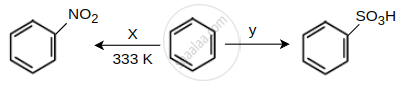
Read the following reaction and answer the questions given below.
\[\begin{array}{cc}
\phantom{..............................}\ce{CH3}\\
\phantom{............................}|\\
\ce{CH3 - C = CH2 + HBr ->[benzoyl][peroxide] CH3 - CH - CH2Br}\\
|\phantom{....................................}\\
\ce{CH3}\phantom{..................................}
\end{array}\]
- Write IUPAC name of the product.
- State the rule that governs formation of this product.
Identify ortho and para-directing groups from the following:
\[\ce{\underset{I}{–CHO},\underset{II}{–NHCOCH3},\underset{III}{–OCH3},\underset{IV}{–SO3H}}\]
