Advertisements
Advertisements
Question
Predict the possible product of the following reaction.
sulphonation of chlorobenzene
Advertisements
Solution
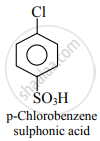
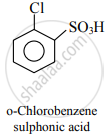
Chloro group is ortho and para directing group. So, sulphonation of chlorobenzene gives p-chlorobenzene sulphonic acid and o- chlorobenzene sulphonic acid.
APPEARS IN
RELATED QUESTIONS
Name the following:
The hydrocarbon said to possess carcinogenic property.
Write the balanced chemical reaction to get benzene from Sodium benzoate.
Predict the possible product of the following reaction.
bromination of phenol
Identify the main product of the reaction:
\[\ce{HC ≡ C - CH3 ->[H2][Pd-C/quinoline]}\] _______.
Identify giving reason whether the following compound is aromatic or not.
Name two reagents used for acylation of benzene.
Read the following reaction and answer the questions given below:

- Write the name of the reaction.
- Identify the electrophile in it.
- How is this electrophile generated?
Which of the following can be used as the halide component for friedal - crafts reaction?
Which of the following is aliphatic saturated hydrocarbon?
Identify the compound 'Z' in the following reaction
\[\ce{C2H6O ->[Al2O3][623 K] X ->[O3] Y ->[Zn/H2O] (Z)}\]
Give IUPAC name for the following compound.
\[\ce{CH ≡ C – C ≡ C – C ≡ CH}\]
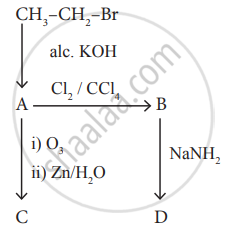
Identify the compound A, B, C and D in the following series of reactions.
Describe the mechanism of Nitration of benzene.
How does Huckel rule help to decide the aromatic character of a compound?
Write the structure of the following alkanes.
5 – (2 – Ethyl butyl) – 3, 3 – dimethyldecane
Write the structure of the following alkanes.
5 – (1, 2 – Dimethyl propyl) – 2 – methylnonane
How will you prepare propane from a sodium salt of fatty acid?
Identify the hydrocarbon compound from following containing carbon atoms in the range of C6 to C8?
A compound with molecular formula C4H4O has all the four carbon atom and the oxygen atom in the ring. It also has two carbon-carbon double bonds. The compound is ____________.
−Cl group is ____________.
Which of the following is INCORRECT for aromatic hydrocarbons?
Which of the following is NOT alicyclic compound?
Sodium benzoate on decarboxylation gives ____________.
Dow's process is used for the synthesis of an aromatic compound (X). Identify X.
Which of the following molecules has shortest C - C bond length?
Benzene reacts with CH3COCl + AICl3 to give ______.
