Advertisements
Advertisements
Question
Describe the mechanism of Nitration of benzene.
Advertisements
Solution
It is prepared by the action of a mixture of con. HNO3 and con. H2SO4 (nitrating mixture) on benzene maintaining the temperature below 333 K.
Nitration:
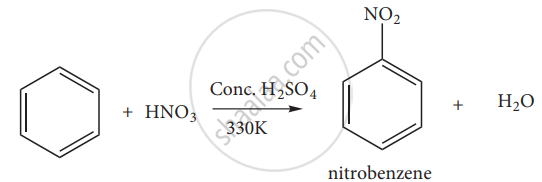
Sulphuric acid generates the electrophile – NO2+, nitronium ion-from nitric acid. This is an example of aromatic electrophilic substitution reaction.
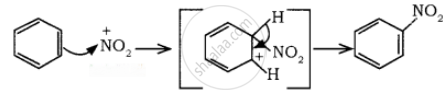
The generation of nitronium ion


To the nitronium ion (being an electron-deficient species) the π bond of benzene, donates a pair of electrons forming a 6-bond. A species with a + ve charge is formed as an intermediate. This is called ‘arenium ion’ and is stabilised by Resonance.

In the last step, the hydrogen atom attached to the carbon carrying the nitro group is pulled out as a proton, by the Lewis base HSO4–, so that stable aromatic system is formed.

APPEARS IN
RELATED QUESTIONS
Name the following:
The hydrocarbon said to possess carcinogenic property.
Some meta-directing substituents in aromatic substitution are given. Which one is most deactivating?
Which of the following is aliphatic saturated hydrocarbon?
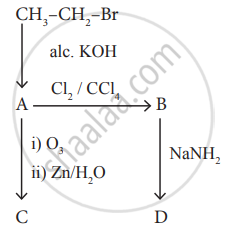
Identify the compound A, B, C and D in the following series of reactions.
What happens when Isobutylene is treated with acidified potassium permanganate?
How will you convert ethyl chloride into n – butane?
Sodium benzoate on decarboxylation gives ____________.
Read the following reaction and answer the questions given below.
\[\begin{array}{cc}
\phantom{..............................}\ce{CH3}\\
\phantom{............................}|\\
\ce{CH3 - C = CH2 + HBr ->[benzoyl][peroxide] CH3 - CH - CH2Br}\\
|\phantom{....................................}\\
\ce{CH_3}\phantom{.................................}
\end{array}\]
- Write the IUPAC name of the product.
- State the rule that governs the formation of this product.
Read the following reaction and answer the questions given below.
\[\begin{array}{cc}
\phantom{...............................}\ce{CH3}\\
\phantom{............................}|\\
\ce{CH3 - C = CH2 + HBr ->[benzoyl][peroxide]CH3 - CH - CH2Br}\\
|\phantom{....................................}\\
\ce{CH3}\phantom{..................................}
\end{array}\]
- Write the IUPAC name of the product.
- State the rule that governs the formation of this product.
Benzene reacts with CH3COCl + AICl3 to give ______.
