Advertisements
Advertisements
Question
Predict the possible product of the following reaction.
bromination of phenol
Advertisements
Solution
Phenolic –OH group is ortho and para directing group. So, the bromination of phenol gives p-bromophenol and o-bromophenol.
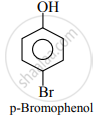
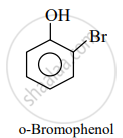
APPEARS IN
RELATED QUESTIONS
Write the balanced chemical reaction to get benzene from Sodium benzoate.
Identify the main product of the reaction.
\[\begin{array}{cc}
\ce{CH3 - CH - CH3 ->[{60%}H2SO4][373 K]}\\
|\phantom{............}\\\ce{OH}\phantom{..........}
\end{array}\] _______.
Identify the main product of the reaction:
\[\ce{H - C ≡ C - H + H - O ->[{40%} H2SO4][{1%} HgSO4]}\] _____.
Identify A, B, C in the following reaction sequence:
\[\ce{CH3 - CH = CH2 ->[Br2/CCl4][room temperature] A ->[Zn] B ->[dil. alkaline][KMnO4] C}\]
Name two reagents used for acylation of benzene.
Which of the following can be used as the halide component for friedal - crafts reaction?
An alkane is obtained by decarboxylation of sodium propionate. Same alkane can be prepared by ______.
Which of the following is aliphatic saturated hydrocarbon?
2 – butyne on chlorination gives ______.
Give IUPAC name for the following compound.
Ethyl isopropyl acetylene
Give IUPAC name for the following compound.
\[\ce{CH ≡ C – C ≡ C – C ≡ CH}\]
Identify the compound A, B, C and D in the following series of reactions.
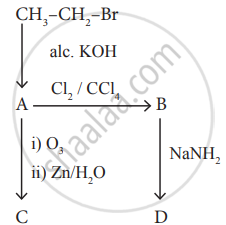
How does Huckel rule help to decide the aromatic character of a compound?
Suggest the route for the preparation of the following from benzene.
Bromo benzene
How will you convert ethyl chloride into ethane?
How will distinguish 1 – butyne and 2 – butyne?
When acetylene is passed through red hot iron tube at 873 K, ____________ is/are obtained as product/s.
Direct bromination of benzene with excess reagent results in the formation of ____________.
Sodium benzoate on decarboxylation gives ____________.
α-butylene when subjected to hydroboration oxidation reaction, yields ____________.
The treatment of benzene with iso - butene in the presence of sulphuric acid gives:
Read the following reaction and answer the questions given below.
\[\begin{array}{cc}
\phantom{..............................}\ce{CH3}\\
\phantom{...........................}|\\
\ce{CH3 - C = CH2 + HBr ->[Benzoyl][peroxide] H3C - CH - CH2Br}\\
|\phantom{....................................}\\
\ce{CH3}\phantom{.................................}
\end{array}\]
- Write the IUPAC name of the product.
- State the rule that governs the formation of this product.
Read the following reaction and answer the questions given below.
\[\begin{array}{cc}
\phantom{.............................}\ce{CH3}\\
\phantom{...........................}|\\
\ce{CH3 - C = CH2 + HBr ->[benzoyl][peroxide] CH3 - CH - CH2Br}\\
|\phantom{....................................}\\
\ce{CH3}\phantom{.................................}\\
\end{array}\]
- Write IUPAC name of the product.
- State the rule that governs formation of this product.
Read the following reaction and answer the questions given below.
\[\begin{array}{cc}
\phantom{..............................}\ce{CH3}\\
\phantom{............................}|\\
\ce{CH3 - C = CH2 + HBr ->[benzoyl][peroxide] CH3 - CH - CH2Br}\\
|\phantom{....................................}\\
\ce{CH_3}\phantom{.................................}
\end{array}\]
- Write the IUPAC name of the product.
- State the rule that governs the formation of this product.
Which of the following statement is NOТ correct for aromatic compounds?
Identify ortho and para-directing groups from the following:
\[\ce{\underset{I}{–CHO},\underset{II}{–NHCOCH3},\underset{III}{–OCH3},\underset{IV}{–SO3H}}\]
