Advertisements
Advertisements
Question
If R is a relation on a finite set having n elements, then the number of relations on A is
Options
(a) 2n
(b) \[2^{n^2}\]
(c) n2
(d) nn
Advertisements
Solution
(b) \[2^{n^2}\]
Given : A finite set with n elements
Its Cartesian product with itself will have n2 elements.
∴ Number of relations on A = \[2^{n^2}\]
APPEARS IN
RELATED QUESTIONS
Let A = {1, 2, 3, …, 14}. Define a relation R from A to A by R = {(x, y): 3x – y = 0, where x, y ∈ A}. Write down its domain, codomain and range.
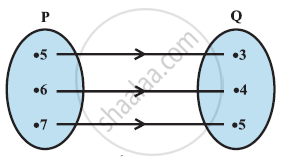
The given figure shows a relationship between the sets P and Q. Write this relation
- in set-builder form.
- in roster form.
What is its domain and range?
Let A = {1, 2, 3, 4, 6}. Let R be the relation on A defined by {(a, b): a, b ∈ A, b is exactly divisible by a}.
- Write R in roster form
- Find the domain of R
- Find the range of R.
Write the relation R = {(x, x3): x is a prime number less than 10} in roster form.
Find the inverse relation R−1 in each of the cases:
(i) R = {(1, 2), (1, 3), (2, 3), (3, 2), (5, 6)}
Determine the domain and range of the relation R defined by
(ii) R = {(x, x3) : x is a prime number less than 10}
Determine the domain and range of the relations:
(ii) \[S = \left\{ \left( a, b \right) : b = \left| a - 1 \right|, a \in Z \text{ and} \left| a \right| \leq 3 \right\}\]
Let A = {a, b}. List all relations on A and find their number.
Let A = [1, 2, 3, 4, 5, 6]. Let R be a relation on A defined by {(a, b) : a, b ∈ A, b is exactly divisible by a}
(i) Writer R in roster form
(ii) Find the domain of R
(ii) Find the range of R.
For the relation R1 defined on R by the rule (a, b) ∈ R1 ⇔ 1 + ab > 0. Prove that: (a, b) ∈ R1 and (b , c) ∈ R1 ⇒ (a, c) ∈ R1 is not true for all a, b, c ∈ R.
If A = {1, 2, 4}, B = {2, 4, 5} and C = {2, 5}, write (A − C) × (B − C).
If R is a relation from set A = (11, 12, 13) to set B = (8, 10, 12) defined by y = x − 3, then write R−1.
Let A and B be two sets such that n(A) = 3 and n(B) = 2. If (x, 1), (y, 2), (z, 1) are in A × B, write A and B
Let A = [1, 2, 3], B = [1, 3, 5]. If relation R from A to B is given by = {(1, 3), (2, 5), (3, 3)}, Then R−1 is
If R is a relation from a finite set A having m elements of a finite set B having n elements, then the number of relations from A to B is
Write the relation in the Roster Form. State its domain and range
R2 = `{("a", 1/"a") // 0 < "a" ≤ 5, "a" ∈ "N"}`
Write the relation in the Roster Form. State its domain and range
R3 = {(x, y)/y = 3x, y∈ {3, 6, 9, 12}, x∈ {1, 2, 3}
Write the relation in the Roster Form. State its domain and range
R5 = {(x, y)/x + y = 3, x, y∈ {0, 1, 2, 3}
Write the relation in the Roster Form. State its domain and range
R8 = {(a, b)/b = a + 2, a ∈ z, 0 < a < 5}
Answer the following:
If A = {1, 2, 3}, B = {4, 5, 6} check if the following are relations from A to B. Also write its domain and range
R2 = {(1, 5), (2, 4), (3, 6)}
Answer the following:
Find R : A → A when A = {1, 2, 3, 4} such that R = (a, b)/a − b = 10}
Answer the following:
R = {1, 2, 3} → {1, 2, 3} given by R = {(1, 1), (2, 2), (3, 3), (1, 2), (2, 3)} Check if R is transitive
Let A = {1, 2, 3, 7} and B = {3, 0, –1, 7}, the following is relation from A to B?
R3 = {(2, –1), (7, 7), (1, 3)}
Discuss the following relation for reflexivity, symmetricity and transitivity:
The relation R defined on the set of all positive integers by “mRn if m divides n”
Discuss the following relation for reflexivity, symmetricity and transitivity:
Let P denote the set of all straight lines in a plane. The relation R defined by “lRm if l is perpendicular to m”
Discuss the following relation for reflexivity, symmetricity and transitivity:
Let A be the set consisting of all the female members of a family. The relation R defined by “aRb if a is not a sister of b”
Let X = {a, b, c, d} and R = {(a, a), (b, b), (a, c)}. Write down the minimum number of ordered pairs to be included to R to make it transitive
Let A = {a, b, c} and R = {(a, a), (b, b), (a, c)}. Write down the minimum number of ordered pairs to be included to R to make it symmetric
Let A = {a, b, c} and R = {(a, a), (b, b), (a, c)}. Write down the minimum number of ordered pairs to be included to R to make it equivalence
On the set of natural numbers let R be the relation defined by aRb if 2a + 3b = 30. Write down the relation by listing all the pairs. Check whether it is reflexive
On the set of natural numbers let R be the relation defined by aRb if 2a + 3b = 30. Write down the relation by listing all the pairs. Check whether it is symmetric
On the set of natural numbers let R be the relation defined by aRb if a + b ≤ 6. Write down the relation by listing all the pairs. Check whether it is transitive
Choose the correct alternative:
Let R be the set of all real numbers. Consider the following subsets of the plane R × R: S = {(x, y) : y = x + 1 and 0 < x < 2} and T = {(x, y) : x − y is an integer} Then which of the following is true?
Is the given relation a function? Give reasons for your answer.
s = {(n, n2) | n is a positive integer}
Which statement about images in a function is correct?
Which statement is true in general for ordered pairs?
Find \(x\) and \(y\) if \((x+3,2)=(4,y-3)\).
For \(A=\{-1,0,1\}\), which ordered pair is a remaining element of \(A\times A\) besides \((-1,0)\) and \((0,1)\)?
