Advertisements
Advertisements
Question
Find the interval in which the following function are increasing or decreasing f(x) = 2x3 − 9x2 + 12x − 5 ?
Advertisements
Solution
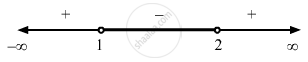
\[\text { When } \left( x - a \right)\left( x - b \right)>0 \text { with }a < b, x < a \text { or }x>b.\]
\[\text { When } \left( x - a \right)\left( x - b \right)<0 \text { with } a < b, a < x < b .\]
\[f\left( x \right) = 2 x^3 - 9 x^2 + 12x - 5\]
\[f'\left( x \right) = 6 x^2 - 18x + 12\]
\[ = 6 \left( x^2 - 3x + 2 \right)\]
\[ = 6 \left( x - 1 \right)\left( x - 2 \right)\]
\[\text{ For }f(x) \text { to be increasing, we must have }\]
\[f'\left( x \right) > 0\]
\[ \Rightarrow 6 \left( x - 1 \right)\left( x - 2 \right) > 0\]
\[ \Rightarrow \left( x - 1 \right)\left( x - 2 \right) > 0 \left[ \text { Since } 6 > 0, 6 \left( x - 1 \right)\left( x - 2 \right) > 0 \Rightarrow \left( x - 1 \right)\left( x - 2 \right) > 0 \right]\]
\[ \Rightarrow x < 1 orx > 2\]
\[ \Rightarrow x \in \left( - \infty , 1 \right) \cup \left( 2, \infty \right)\]
\[\text { So },f(x)\text { is increasing on } x \in \left( - \infty , 1 \right) \cup \left( 2, \infty \right).\]

\[\text { For }f(x) \text { to be decreasing, we must have }\]
\[f'\left( x \right) < 0\]
\[ \Rightarrow 6 \left( x - 1 \right)\left( x - 2 \right) < 0\]
\[ \Rightarrow \left( x - 1 \right)\left( x - 2 \right) < 0 \left[ \text { Since } 6 > 0, 6 \left( x - 1 \right)\left( x - 2 \right) < 0 \Rightarrow \left( x - 1 \right)\left( x - 2 \right) < 0 \right]\]
\[ \Rightarrow 1 < x < 2\]
\[ \Rightarrow x \in \left( 1, 2 \right)\]
\[\text { So} ,f(x)\text { is decreasing on } x \in \left( 1, 2 \right) .\]
APPEARS IN
RELATED QUESTIONS
Show that the function given by f(x) = 3x + 17 is strictly increasing on R.
Show that the function given by f(x) = sin x is
- strictly increasing in `(0, pi/2)`
- strictly decreasing in `(pi/2, pi)`
- neither increasing nor decreasing in (0, π)
Find the interval in which the following function are increasing or decreasing f(x) = 10 − 6x − 2x2 ?
Find the interval in which the following function are increasing or decreasing f(x) = −2x3 − 9x2 − 12x + 1 ?
Show that f(x) = loga x, 0 < a < 1 is a decreasing function for all x > 0 ?
Show that f(x) = x − sin x is increasing for all x ∈ R ?
Show that f(x) = tan x is an increasing function on (−π/2, π/2) ?
Show that f(x) = x9 + 4x7 + 11 is an increasing function for all x ∈ R ?
Find the intervals in which f(x) = (x + 2) e−x is increasing or decreasing ?
Write the set of values of 'a' for which f(x) = loga x is decreasing in its domain ?
Find 'a' for which f(x) = a (x + sin x) + a is increasing on R ?
Write the set of values of k for which f(x) = kx − sin x is increasing on R ?
If g (x) is a decreasing function on R and f(x) = tan−1 [g (x)]. State whether f(x) is increasing or decreasing on R ?
Function f(x) = x3 − 27x + 5 is monotonically increasing when ______.
Every invertible function is
The price P for demand D is given as P = 183 + 120 D – 3D2.
Find D for which the price is increasing.
Find the value of x, such that f(x) is decreasing function.
f(x) = 2x3 - 15x2 - 144x - 7
State whether the following statement is True or False:
The function f(x) = `"x"*"e"^("x" (1 - "x"))` is increasing on `((-1)/2, 1)`.
Show that function f(x) =`3/"x" + 10`, x ≠ 0 is decreasing.
A man of height 1.9 m walks directly away from a lamp of height 4.75m on a level road at 6m/s. The rate at which the length of his shadow is increasing is
The function f(x) = 9 - x5 - x7 is decreasing for
For which interval the given function f(x) = 2x3 – 9x2 + 12x + 7 is increasing?
Let f(x) = x3 + 9x2 + 33x + 13, then f(x) is ______.
For every value of x, the function f(x) = `1/7^x` is ______
The values of k for which the function f(x) = kx3 – 6x2 + 12x + 11 may be increasing on R are ______.
If f(x) = `x^(3/2) (3x - 10)`, x ≥ 0, then f(x) is increasing in ______.
Determine for which values of x, the function y = `x^4 – (4x^3)/3` is increasing and for which values, it is decreasing.
y = x(x – 3)2 decreases for the values of x given by : ______.
The function f(x) = 4 sin3x – 6 sin2x + 12 sinx + 100 is strictly ______.
Let `"f (x) = x – cos x, x" in "R"`, then f is ____________.
2x3 - 6x + 5 is an increasing function, if ____________.
The interval in which `y = x^2e^(-x)` is increasing with respect to `x` is
y = log x satisfies for x > 1, the inequality ______.
Let f : R `rightarrow` R be a positive increasing function with `lim_(x rightarrow ∞) (f(3x))/(f(x))` = 1 then `lim_(x rightarrow ∞) (f(2x))/(f(x))` = ______.
Let f(x) = `x/sqrt(a^2 + x^2) - (d - x)/sqrt(b^2 + (d - x)^2), x ∈ R` where a, b and d are non-zero real constants. Then ______.
The function f(x) = sin4x + cos4x is an increasing function if ______.
Let \[f\] be continuous on \[[a,b]\] and differentiable on \[(a,b)\]. If \[f'(x)\geq0\] for every \[x\in(a,b)\], what follows?
As one moves from left to right on a graph, what does a decrease in the \[y\]-values indicate?
As one moves from left to right on a graph, what do constant \[y\]-values indicate?
For \[f(x)=4x^3-6x^2-72x+30\], which factorization of \[f'(x)\] is correct?
