Advertisements
Advertisements
Question
The interval in which the function f(x) = 2x3 + 9x2 + 12x – 1 is decreasing is ______.
Options
(– 1, ∞)
(– 2, – 1)
(– ∞, – 2)
[– 1, 1]
Advertisements
Solution
The interval in which the function f(x) = 2x3 + 9x2 + 12x – 1 is decreasing is (– 2, – 1).
Explanation:
Given,
f(x) = 2x3 + 9x2 + 12x – 1
f'(x) = 6x2 + 18x + 12 = 6(x2 + 3x + 2)
For increasing or decreasing, f'(x) = a
x2 + 3x + 2 = 0
`\implies` x = – 1, – 2
Sign scheme indicates
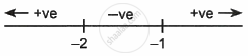
So the function is decreasing in (– 2, – 1).
APPEARS IN
RELATED QUESTIONS
The function f (x) = x3 – 3x2 + 3x – 100, x∈ R is _______.
(A) increasing
(B) decreasing
(C) increasing and decreasing
(D) neither increasing nor decreasing
Find the least value of a such that the function f given by f (x) = x2 + ax + 1 is strictly increasing on [1, 2].
Find the interval in which the following function are increasing or decreasing f(x) = 2x3 − 15x2 + 36x + 1 ?
Find the interval in which the following function are increasing or decreasing f(x) = 2x3 − 24x + 7 ?
Find the interval in which the following function are increasing or decreasing f(x) = x4 − 4x ?
Find the interval in which the following function are increasing or decreasing f(x) = x3 − 6x2 + 9x + 15 ?
Find the interval in which the following function are increasing or decreasing \[f\left( x \right) = \log\left( 2 + x \right) - \frac{2x}{2 + x}, x \in R\] ?
Find the intervals in which f(x) = sin x − cos x, where 0 < x < 2π is increasing or decreasing ?
Show that f(x) = cos2 x is a decreasing function on (0, π/2) ?
Determine whether f(x) = −x/2 + sin x is increasing or decreasing on (−π/3, π/3) ?
Find the intervals in which f(x) = (x + 2) e−x is increasing or decreasing ?
Show that f(x) = x2 − x sin x is an increasing function on (0, π/2) ?
Find the interval in which f(x) is increasing or decreasing f(x) = x|x|, x \[\in\] R ?
Find the interval in which f(x) is increasing or decreasing f(x) = sinx(1 + cosx), 0 < x < \[\frac{\pi}{2}\] ?
Find 'a' for which f(x) = a (x + sin x) + a is increasing on R ?
The interval of increase of the function f(x) = x − ex + tan (2π/7) is
If the function f(x) = cos |x| − 2ax + b increases along the entire number scale, then
Test whether the following functions are increasing or decreasing : f(x) = 2 – 3x + 3x2 – x3, x ∈ R.
Solve the following : Find the intervals on which the function y = xx, (x > 0) is increasing and decreasing.
By completing the following activity, find the values of x such that f(x) = 2x3 – 15x2 – 84x – 7 is decreasing function.
Solution: f(x) = 2x3 – 15x2 – 84x – 7
∴ f'(x) = `square`
∴ f'(x) = 6`(square) (square)`
Since f(x) is decreasing function.
∴ f'(x) < 0
Case 1: `(square)` > 0 and (x + 2) < 0
∴ x ∈ `square`
Case 2: `(square)` < 0 and (x + 2) > 0
∴ x ∈ `square`
∴ f(x) is decreasing function if and only if x ∈ `square`
Given P(x) = x4 + ax3 + bx2 + cx + d such that x = 0 is the only real root of P'(x) = 0. If P(-1) < P(1), then in the interval [-1, 1] ______
Let the f : R → R be defined by f (x) = 2x + cosx, then f : ______.
The function f(x) = mx + c where m, c are constants, is a strict decreasing function for all `"x" in "R"` , if ____________.
The interval in which the function f is given by f(x) = x2 e-x is strictly increasing, is: ____________.
The function f: N → N, where
f(n) = `{{:(1/2(n + 1), "If n is sold"),(1/2n, "if n is even"):}` is
Find the interval in which the function `f` is given by `f(x) = 2x^2 - 3x` is strictly decreasing.
State whether the following statement is true or false.
If f'(x) > 0 for all x ∈ (a, b) then f(x) is decreasing function in the interval (a, b).
In which one of the following intervals is the function f(x) = x3 – 12x increasing?
A function \[f\] is monotonic in an interval when it is which of the following?
