Advertisements
Advertisements
प्रश्न
The interval in which the function f(x) = 2x3 + 9x2 + 12x – 1 is decreasing is ______.
विकल्प
(– 1, ∞)
(– 2, – 1)
(– ∞, – 2)
[– 1, 1]
Advertisements
उत्तर
The interval in which the function f(x) = 2x3 + 9x2 + 12x – 1 is decreasing is (– 2, – 1).
Explanation:
Given,
f(x) = 2x3 + 9x2 + 12x – 1
f'(x) = 6x2 + 18x + 12 = 6(x2 + 3x + 2)
For increasing or decreasing, f'(x) = a
x2 + 3x + 2 = 0
`\implies` x = – 1, – 2
Sign scheme indicates
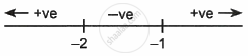
So the function is decreasing in (– 2, – 1).
APPEARS IN
संबंधित प्रश्न
The amount of pollution content added in air in a city due to x-diesel vehicles is given by P(x) = 0.005x3 + 0.02x2 + 30x. Find the marginal increase in pollution content when 3 diesel vehicles are added and write which value is indicated in the above question.
Show that the function given by f(x) = sin x is
- strictly increasing in `(0, pi/2)`
- strictly decreasing in `(pi/2, pi)`
- neither increasing nor decreasing in (0, π)
Prove that the function given by f (x) = x3 – 3x2 + 3x – 100 is increasing in R.
The interval in which y = x2 e–x is increasing is ______.
Find the intervals in which the function f given by `f(x) = x^3 + 1/x^3 x != 0`, is (i) increasing (ii) decreasing.
Prove that f(x) = ax + b, where a, b are constants and a < 0 is a decreasing function on R ?
Find the interval in which the following function are increasing or decreasing f(x) = x3 − 6x2 + 9x + 15 ?
Prove that the function f given by f(x) = x − [x] is increasing in (0, 1) ?
Find the interval in which f(x) is increasing or decreasing f(x) = x|x|, x \[\in\] R ?
The function f(x) = x2 e−x is monotonic increasing when
In the interval (1, 2), function f(x) = 2 | x − 1 | + 3 | x − 2 | is
Find the intervals in which the function \[f(x) = \frac{3}{2} x^4 - 4 x^3 - 45 x^2 + 51\] is
(a) strictly increasing
(b) strictly decreasing
Find `dy/dx,if e^x+e^y=e^(x-y)`
Find the value of x, such that f(x) is decreasing function.
f(x) = 2x3 – 15x2 – 84x – 7
Find the value of x such that f(x) is decreasing function.
f(x) = x4 − 2x3 + 1
Show that f(x) = x – cos x is increasing for all x.
The function f(x) = `x - 1/x`, x ∈ R, x ≠ 0 is increasing
f(x) = `{{:(0"," x = 0 ), (x - 3"," x > 0):}` The function f(x) is ______
2x3 - 6x + 5 is an increasing function, if ____________.
The function which is neither decreasing nor increasing in `(pi/2,(3pi)/2)` is ____________.
The interval in which `y = x^2e^(-x)` is increasing with respect to `x` is
Find the value of x for which the function f(x)= 2x3 – 9x2 + 12x + 2 is decreasing.
Given f(x) = 2x3 – 9x2 + 12x + 2
∴ f'(x) = `squarex^2 - square + square`
∴ f'(x) = `6(x - 1)(square)`
Now f'(x) < 0
∴ 6(x – 1)(x – 2) < 0
Since ab < 0 ⇔a < 0 and b < 0 or a > 0 and b < 0
Case 1: (x – 1) < 0 and (x – 2) < 0
∴ x < `square` and x > `square`
Which is contradiction
Case 2: x – 1 and x – 2 < 0
∴ x > `square` and x < `square`
1 < `square` < 2
f(x) is decreasing if and only if x ∈ `square`
Function f(x) = `log(1 + x) - (2x)/(2 + x)` is monotonically increasing when ______.
Function f(x) = x100 + sinx – 1 is increasing for all x ∈ ______.
The function f(x) = tan–1(sin x + cos x) is an increasing function in ______.
The intevral in which the function f(x) = 5 + 36x – 3x2 increases will be ______.
Find the values of x for which the function f(x) = `x/(x^2 + 1)` is strictly decreasing.
Find the interval in which the function f(x) = x2e–x is strictly increasing or decreasing.
In the procedure for finding intervals, which conclusion is correct when \[f'(x)<0\]?
