Advertisements
Advertisements
प्रश्न
The interval in which the function f(x) = 2x3 + 9x2 + 12x – 1 is decreasing is ______.
पर्याय
(– 1, ∞)
(– 2, – 1)
(– ∞, – 2)
[– 1, 1]
Advertisements
उत्तर
The interval in which the function f(x) = 2x3 + 9x2 + 12x – 1 is decreasing is (– 2, – 1).
Explanation:
Given,
f(x) = 2x3 + 9x2 + 12x – 1
f'(x) = 6x2 + 18x + 12 = 6(x2 + 3x + 2)
For increasing or decreasing, f'(x) = a
x2 + 3x + 2 = 0
`\implies` x = – 1, – 2
Sign scheme indicates
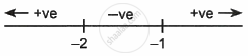
So the function is decreasing in (– 2, – 1).
APPEARS IN
संबंधित प्रश्न
Find the intervals in which the function f given by f(x) = 2x2 − 3x is
- strictly increasing
- strictly decreasing
Find the intervals in which the function `f(x) = x^4/4 - x^3 - 5x^2 + 24x + 12` is (a) strictly increasing, (b) strictly decreasing
Prove that the function f(x) = loge x is increasing on (0, ∞) ?
Without using the derivative show that the function f (x) = 7x − 3 is strictly increasing function on R ?
Find the interval in which the following function are increasing or decreasing f(x) = 10 − 6x − 2x2 ?
Find the interval in which the following function are increasing or decreasing f(x) = 5x3 − 15x2 − 120x + 3 ?
Find the interval in which the following function are increasing or decreasing \[f\left( x \right) = 3 x^4 - 4 x^3 - 12 x^2 + 5\] ?
Prove that the function f(x) = x3 − 6x2 + 12x − 18 is increasing on R ?
Show that f(x) = tan−1 x − x is a decreasing function on R ?
Prove that the function f given by f(x) = x − [x] is increasing in (0, 1) ?
What are the values of 'a' for which f(x) = ax is decreasing on R ?
Write the set of values of 'a' for which f(x) = loga x is increasing in its domain ?
Find 'a' for which f(x) = a (x + sin x) + a is increasing on R ?
Find the set of values of 'b' for which f(x) = b (x + cos x) + 4 is decreasing on R ?
If the function f(x) = kx3 − 9x2 + 9x + 3 is monotonically increasing in every interval, then
The function \[f\left( x \right) = \frac{\lambda \sin x + 2 \cos x}{\sin x + \cos x}\] is increasing, if
Using truth table show that ∼ (p → ∼ q) ≡ p ∧ q
Prove that the function f : N → N, defined by f(x) = x2 + x + 1 is one-one but not onto. Find the inverse of f: N → S, where S is range of f.
Find the values of x for which the function f(x) = 2x3 – 6x2 + 6x + 24 is strictly increasing
The sides of a square are increasing at the rate of 0.2 cm/sec. When the side is 25cm long, its area is increasing at the rate of ______
Show that f(x) = tan–1(sinx + cosx) is an increasing function in `(0, pi/4)`
The function f(x) = 4 sin3x – 6 sin2x + 12 sinx + 100 is strictly ______.
The function f(x) = x2 – 2x is increasing in the interval ____________.
The interval in which the function f is given by f(x) = x2 e-x is strictly increasing, is: ____________.
`"f"("x") = (("e"^(2"x") - 1)/("e"^(2"x") + 1))` is ____________.
Find the interval in which the function `f` is given by `f(x) = 2x^2 - 3x` is strictly decreasing.
The interval in which `y = x^2e^(-x)` is increasing with respect to `x` is
Find the value of x for which the function f(x)= 2x3 – 9x2 + 12x + 2 is decreasing.
Given f(x) = 2x3 – 9x2 + 12x + 2
∴ f'(x) = `squarex^2 - square + square`
∴ f'(x) = `6(x - 1)(square)`
Now f'(x) < 0
∴ 6(x – 1)(x – 2) < 0
Since ab < 0 ⇔a < 0 and b < 0 or a > 0 and b < 0
Case 1: (x – 1) < 0 and (x – 2) < 0
∴ x < `square` and x > `square`
Which is contradiction
Case 2: x – 1 and x – 2 < 0
∴ x > `square` and x < `square`
1 < `square` < 2
f(x) is decreasing if and only if x ∈ `square`
Let f : R `rightarrow` R be a positive increasing function with `lim_(x rightarrow ∞) (f(3x))/(f(x))` = 1 then `lim_(x rightarrow ∞) (f(2x))/(f(x))` = ______.
In the procedure for finding intervals, which conclusion is correct when \[f'(x)<0\]?
