Advertisements
Advertisements
Question
Find the interval in which the following function are increasing or decreasing \[f\left( x \right) = \log\left( 2 + x \right) - \frac{2x}{2 + x}, x \in R\] ?
Advertisements
Solution
\[\text { When } \left( x - a \right)\left( x - b \right)>0 \text { with }a < b, x < a \text { or }x>b.\]
\[\text { When } \left( x - a \right)\left( x - b \right)<0 \text { with } a < b, a < x < b .\]
\[f\left( x \right) = \log\left( 2 + x \right) - \frac{2x}{2 + x}, x \in R\]
\[f'\left( x \right) = \frac{1}{\left( 2 + x \right)} - \frac{\left[ \left( 2 + x \right)2 - 2x \right]}{\left( 2 + x \right)^2}\]
\[ = \frac{\left( 2 + x \right) - \left[ 4 + 2x - 2x \right]}{\left( 2 + x \right)^2}\]
\[ = \frac{2 + x - 4}{\left( 2 + x \right)^2}\]
\[ = \frac{\left( x - 2 \right)}{\left( 2 + x \right)^2}, x \neq - 2\]
\[\text{ Here, x = 2 is the critical point}.\]
\[\text { The possible intervals are }\left( - \infty , 2 \right)\text { and }\left( 2, \infty \right). .....(1)\]
\[\text { For f(x) to be increasing, we must have }\]
\[f'\left( x \right) > 0\]
\[ \Rightarrow \frac{\left( x - 2 \right)}{\left( 2 + x \right)^2} > 0\]
\[ \Rightarrow x - 2 > 0, x \neq - 2\]
\[ \Rightarrow x > 2\]
\[ \Rightarrow x \in \left( 2, \infty \right) \left[ \text { From eq. } (1) \right]\]
\[\text{ So,f(x)is increasing on x }\in \left( 2, \infty \right) .\]
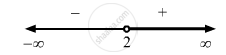
\[\text { For f(x) to be decreasing, we must have }\]
\[f'\left( x \right) < 0\]
\[ \Rightarrow \frac{\left( x - 2 \right)}{\left( 2 + x \right)^2} < 0\]
\[ \Rightarrow x - 2 < 0, x \neq - 2\]
\[ \Rightarrow x < 2\]
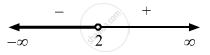
\[ \Rightarrow x \in \left( - \infty , 2 \right) \left[ \text { From eq.} (1) \right]\]
\[\text { So,f(x)is decreasing on x }\in \left( - \infty , 2 \right) .\]
APPEARS IN
RELATED QUESTIONS
Find the intervals in which the function f(x) = 3x4 − 4x3 − 12x2 + 5 is
(a) strictly increasing
(b) strictly decreasing
Find the intervals in which f(x) = sin 3x – cos 3x, 0 < x < π, is strictly increasing or strictly decreasing.
Find the intervals in which the function f given by f(x) = 2x2 − 3x is
- strictly increasing
- strictly decreasing
Find the least value of a such that the function f given by f (x) = x2 + ax + 1 is strictly increasing on [1, 2].
Let f be a function defined on [a, b] such that f '(x) > 0, for all x ∈ (a, b). Then prove that f is an increasing function on (a, b).
Without using the derivative, show that the function f (x) = | x | is.
(a) strictly increasing in (0, ∞)
(b) strictly decreasing in (−∞, 0) .
Find the interval in which the following function are increasing or decreasing f(x) = 10 − 6x − 2x2 ?
Find the interval in which the following function are increasing or decreasing f(x) = 2x3 − 15x2 + 36x + 1 ?
Find the interval in which the following function are increasing or decreasing f(x) = 2x3 − 24x + 107 ?
Find the interval in which the following function are increasing or decreasing \[f\left( x \right) = \frac{x^4}{4} + \frac{2}{3} x^3 - \frac{5}{2} x^2 - 6x + 7\] ?
Show that f(x) = log sin x is increasing on (0, π/2) and decreasing on (π/2, π) ?
Show that f(x) = tan x is an increasing function on (−π/2, π/2) ?
Show that f(x) = tan−1 (sin x + cos x) is a decreasing function on the interval (π/4, π/2) ?
Prove that the following function is increasing on R f \[(x) =\]3 \[x^5\] + 40 \[x^3\] + 240\[x\] ?
If g (x) is a decreasing function on R and f(x) = tan−1 [g (x)]. State whether f(x) is increasing or decreasing on R ?
Let f(x) = x3 + ax2 + bx + 5 sin2x be an increasing function on the set R. Then, a and b satisfy.
Find the intervals in which the function \[f(x) = \frac{3}{2} x^4 - 4 x^3 - 45 x^2 + 51\] is
(a) strictly increasing
(b) strictly decreasing
Find the values of x for which the following functions are strictly increasing : f(x) = 2x3 – 3x2 – 12x + 6
Show that f(x) = x – cos x is increasing for all x.
Find the value of x, such that f(x) is decreasing function.
f(x) = 2x3 - 15x2 - 144x - 7
For manufacturing x units, labour cost is 150 – 54x and processing cost is x2. Price of each unit is p = 10800 – 4x2. Find the values of x for which Revenue is increasing.
Show that function f(x) =`("x - 2")/("x + 1")`, x ≠ -1 is increasing.
Show that the function f(x) = x3 + 10x + 7 for x ∈ R is strictly increasing
By completing the following activity, find the values of x such that f(x) = 2x3 – 15x2 – 84x – 7 is decreasing function.
Solution: f(x) = 2x3 – 15x2 – 84x – 7
∴ f'(x) = `square`
∴ f'(x) = 6`(square) (square)`
Since f(x) is decreasing function.
∴ f'(x) < 0
Case 1: `(square)` > 0 and (x + 2) < 0
∴ x ∈ `square`
Case 2: `(square)` < 0 and (x + 2) > 0
∴ x ∈ `square`
∴ f(x) is decreasing function if and only if x ∈ `square`
For every value of x, the function f(x) = `1/"a"^x`, a > 0 is ______.
The sides of a square are increasing at the rate of 0.2 cm/sec. When the side is 25cm long, its area is increasing at the rate of ______
Given P(x) = x4 + ax3 + bx2 + cx + d such that x = 0 is the only real root of P'(x) = 0. If P(-1) < P(1), then in the interval [-1, 1] ______
Show that for a ≥ 1, f(x) = `sqrt(3)` sinx – cosx – 2ax + b ∈ is decreasing in R
Show that f(x) = tan–1(sinx + cosx) is an increasing function in `(0, pi/4)`
Which of the following functions is decreasing on `(0, pi/2)`?
The function f(x) = `(2x^2 - 1)/x^4`, x > 0, decreases in the interval ______.
The function f (x) = 2 – 3 x is ____________.
The interval in which the function f is given by f(x) = x2 e-x is strictly increasing, is: ____________.
The interval in which `y = x^2e^(-x)` is increasing with respect to `x` is
If f(x) = x3 + 4x2 + λx + 1(λ ∈ R) is a monotonically decreasing function of x in the largest possible interval `(–2, (–2)/3)` then ______.
y = log x satisfies for x > 1, the inequality ______.
Let f(x) = x3 – 6x2 + 9x + 18, then f(x) is strictly increasing in ______.
If \[f'(x)<0\] throughout an interval, then \[f\] is
