Advertisements
Advertisements
प्रश्न
Find the interval in which the following function are increasing or decreasing \[f\left( x \right) = \log\left( 2 + x \right) - \frac{2x}{2 + x}, x \in R\] ?
Advertisements
उत्तर
\[\text { When } \left( x - a \right)\left( x - b \right)>0 \text { with }a < b, x < a \text { or }x>b.\]
\[\text { When } \left( x - a \right)\left( x - b \right)<0 \text { with } a < b, a < x < b .\]
\[f\left( x \right) = \log\left( 2 + x \right) - \frac{2x}{2 + x}, x \in R\]
\[f'\left( x \right) = \frac{1}{\left( 2 + x \right)} - \frac{\left[ \left( 2 + x \right)2 - 2x \right]}{\left( 2 + x \right)^2}\]
\[ = \frac{\left( 2 + x \right) - \left[ 4 + 2x - 2x \right]}{\left( 2 + x \right)^2}\]
\[ = \frac{2 + x - 4}{\left( 2 + x \right)^2}\]
\[ = \frac{\left( x - 2 \right)}{\left( 2 + x \right)^2}, x \neq - 2\]
\[\text{ Here, x = 2 is the critical point}.\]
\[\text { The possible intervals are }\left( - \infty , 2 \right)\text { and }\left( 2, \infty \right). .....(1)\]
\[\text { For f(x) to be increasing, we must have }\]
\[f'\left( x \right) > 0\]
\[ \Rightarrow \frac{\left( x - 2 \right)}{\left( 2 + x \right)^2} > 0\]
\[ \Rightarrow x - 2 > 0, x \neq - 2\]
\[ \Rightarrow x > 2\]
\[ \Rightarrow x \in \left( 2, \infty \right) \left[ \text { From eq. } (1) \right]\]
\[\text{ So,f(x)is increasing on x }\in \left( 2, \infty \right) .\]
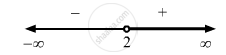
\[\text { For f(x) to be decreasing, we must have }\]
\[f'\left( x \right) < 0\]
\[ \Rightarrow \frac{\left( x - 2 \right)}{\left( 2 + x \right)^2} < 0\]
\[ \Rightarrow x - 2 < 0, x \neq - 2\]
\[ \Rightarrow x < 2\]
\[ \Rightarrow x \in \left( - \infty , 2 \right) \left[ \text { From eq.} (1) \right]\]
\[\text { So,f(x)is decreasing on x }\in \left( - \infty , 2 \right) .\]
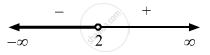
APPEARS IN
संबंधित प्रश्न
Test whether the function is increasing or decreasing.
f(x) = `"x" -1/"x"`, x ∈ R, x ≠ 0,
Prove that y = `(4sin theta)/(2 + cos theta) - theta` is an increasing function of θ in `[0, pi/2]`
Prove that the function f given by f(x) = x2 − x + 1 is neither strictly increasing nor strictly decreasing on (−1, 1).
The interval in which y = x2 e–x is increasing is ______.
Show that f(x) = \[\frac{1}{1 + x^2}\] decreases in the interval [0, ∞) and increases in the interval (−∞, 0] ?
Find the interval in which the following function are increasing or decreasing f(x) = 2x3 − 15x2 + 36x + 1 ?
Find the interval in which the following function are increasing or decreasing f(x) = −2x3 − 9x2 − 12x + 1 ?
Find the interval in which the following function are increasing or decreasing \[f\left( x \right) = \left\{ x(x - 2) \right\}^2\] ?
Show that f(x) = log sin x is increasing on (0, π/2) and decreasing on (π/2, π) ?
Let f defined on [0, 1] be twice differentiable such that | f (x) | ≤ 1 for all x ∈ [0, 1]. If f(0) = f(1), then show that | f'(x) | < 1 for all x ∈ [ 0, 1] ?
Find the interval in which f(x) is increasing or decreasing f(x) = sinx(1 + cosx), 0 < x < \[\frac{\pi}{2}\] ?
What are the values of 'a' for which f(x) = ax is decreasing on R ?
Find the set of values of 'a' for which f(x) = x + cos x + ax + b is increasing on R ?
If the function f(x) = 2x2 − kx + 5 is increasing on [1, 2], then k lies in the interval
If the function f(x) = 2 tan x + (2a + 1) loge | sec x | + (a − 2) x is increasing on R, then
Function f(x) = 2x3 − 9x2 + 12x + 29 is monotonically decreasing when
Function f(x) = loga x is increasing on R, if
Let ϕ(x) = f(x) + f(2a − x) and f"(x) > 0 for all x ∈ [0, a]. Then, ϕ (x)
If the function f(x) = x2 − kx + 5 is increasing on [2, 4], then
The function f(x) = x9 + 3x7 + 64 is increasing on
Show that the function f given by f(x) = tan–1 (sin x + cos x) is decreasing for all \[x \in \left( \frac{\pi}{4}, \frac{\pi}{2} \right) .\]
Find the intervals in which the function \[f(x) = \frac{3}{2} x^4 - 4 x^3 - 45 x^2 + 51\] is
(a) strictly increasing
(b) strictly decreasing
Find the intervals in which the function `f("x") = (4sin"x")/(2+cos"x") -"x";0≤"x"≤2pi` is strictly increasing or strictly decreasing.
Solve the following : Find the intervals on which the function y = xx, (x > 0) is increasing and decreasing.
Find the value of x, such that f(x) is increasing function.
f(x) = x2 + 2x - 5
Show that f(x) = x – cos x is increasing for all x.
The price P for the demand D is given as P = 183 + 120D − 3D2, then the value of D for which price is increasing, is ______.
The function f(x) = tanx – x ______.
The values of a for which the function f(x) = sinx – ax + b increases on R are ______.
The function f(x) = x2 – 2x is increasing in the interval ____________.
The function f(x) = mx + c where m, c are constants, is a strict decreasing function for all `"x" in "R"` , if ____________.
The function f: N → N, where
f(n) = `{{:(1/2(n + 1), "If n is sold"),(1/2n, "if n is even"):}` is
If f(x) = x5 – 20x3 + 240x, then f(x) satisfies ______.
If f(x) = x + cosx – a then ______.
As one moves from left to right on a graph, what does an increase in the \[y\]-values indicate?
For \[f(x)=4x^3-6x^2-72x+30\], which factorization of \[f'(x)\] is correct?
Which statement about \[f'(x)=0\] and constant behaviour is correct?
